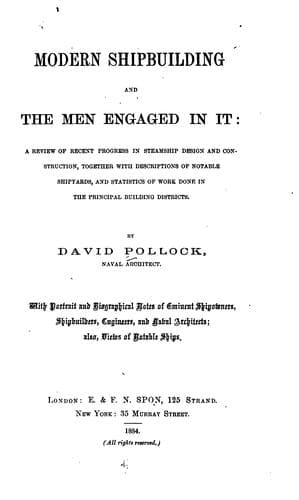
Modern shipbuilding and the men engaged in itPollock, David
History
Modern shipbuilding and the men engaged in it
Pollock, David
Shipbuilding -- Great Britain
[23] From experimental data obtained by Mr Froude, this correction
can be made with certainty. The reasons for it may be explained as
follows:—If an extremely thin short plane is drawn through the water
it meets a certain resistance due entirely to surface-friction; that
is, supposing the plane to be thin enough to eliminate wave-making
and eddy-making. If the length of the plane is doubled while the
depth is kept the same, the resistance at the same speed is not, as
might at first appear to be the case, doubled accordingly. Owing to
the friction of (say) the first half of the plane, the water is made
to partake of the motion of the plane, so that the second half of
the length, rubbing not against stationary water, but against water
partially moving in its own direction, does not experience so much
resistance from it. Adding a third equal length, it would have less
surface friction than the second, and so on to infinity.
[24] See papers by Mr Mansel, enumerated in list at end of chapter.
[25] For description of apparatus, see Trans. Inst. Mechanical
Engineers, 1877.
[26] A body which shortly afterwards joined with a kindred society in
forming the “Institution of Engineers and Shipbuilders in Scotland,”
hereafter noticed.
[27] Following the methods laid down in the Treatise on Shipbuilding,
edited by Prof. Rankine, Mr John Inglis, Pointhouse, instituted
calculations in 1873 of the longitudinal strains of two steamers
built by his firm, the form of the waves being assumed trochoidal.
The result of these calculations—which, under Mr Inglis’ directions,
were got out by Mr G. L. Watson, subsequently distinguished as a
yacht designer, and then in the employ of Messrs Inglis—appeared in
the form of curves of hogging moments in _Engineering_ for 1st May,
1874. Mr Inglis found that entering upon the work of calculation had
a very decided effect in giving him clearer ideas of how distribution
of weight and buoyancy affected the structure of a vessel.
[28] The substance of this paper is contained in a series of three
articles on the Strength and Strains of Ships given in “Naval
Science” (vol. i. and ii., 1872-3), a high-class journal ably edited
by Sir E. J. Reed, but unfortunately abandoned after the fourth year
of publication.
[29] It should be stated that under certain circumstances of lading
and support the value assigned by Mr John for the maximum bending
moment may be exceeded in merchant vessels, and that in some special
classes of ships—particularly light-draught vessels in certain
circumstances of lading and support—the sagging moment may prove of
most consequence. Instances are indeed on record of light-draught
vessels giving way completely under the excessive sagging strain
brought upon them at sea.
Public-domain text, read in full here on John Shaqi.
Reviews
Reviews
No reviews yet
Be the first to share your thoughts on this work.
Elsewhere in the archive
Join the Discussion
Join the discussion
Sign in to leave a comment or review.
Sign InorCreate an account