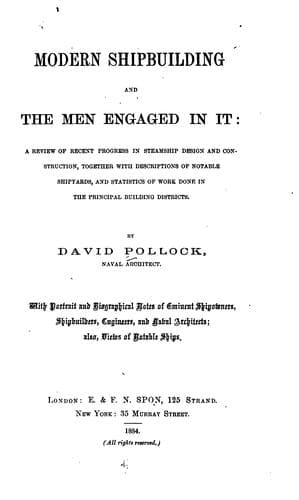
Modern shipbuilding and the men engaged in itPollock, David
History
Modern shipbuilding and the men engaged in it
Pollock, David
Shipbuilding -- Great Britain
In July, 1882, the Steel Company of Scotland (Limited), who are the
manufacturers in Scotland of Messrs Cooke & Mylchreest’s patent form
of rudders and stern-frames, successfully cast a stern-frame—the
first of large size, it is believed, made for actual use in the
construction of a steamer. In April of the same year, however,
Messrs William Jessop & Sons (Limited), of Sheffield, had exhibited
a crucible cast steel stern-frame and rudder of their manufacture,
at the Naval and Sub-Marine Exhibition, held in London. These large
castings, along with others, were subjected to a series of tests in
the presence of Lloyd’s inspectors and other authorities, such as
the forged frames and rudders ordinarily fitted would not have come
through without severe damage, yet all of which the steel castings
withstood most thoroughly.
Testimony to the efficiency of these new features in ship
construction has already been furnished from the arena of actual
experience, by the recent grounding of two steamers in which these
features had been introduced. The screw-steamer _Euripides_, a
Liverpool-owned vessel of about 1780 tons gross, completed in May,
1883, by Messrs Caird & Purdie, of Barrow, some time ago ran upon a
reef of boulders, and remained thumping heavily for several hours.
At the time she was laden with a full cargo of grain, which was
afterwards delivered in perfect condition. The cast steel stem
and stern-frame, which were manufactured by the Steel Company of
Scotland, were practically without damage, notwithstanding that
serious indentations were made in them. The stem, although receiving
the full force of resistance, was not perceptibly altered in shape,
and competent judges who inspected the damage in dock were of opinion
that the stem, with its superior attachments, in all probability
saved the vessel from total loss. The rudder on the _Euripides_ is
of solid cast steel, in one piece, and hung without pintles, and
in a manner involving little or no riveting. In this, as in the
other features, the immunity from serious damage testifies to the
efficiency and durability of the steel castings. The second case of
grounding referred to is that of the screw-steamer _Strathnairn_,
of 400 tons, belonging to Messrs James Hay & Sons, of Glasgow;
one of two vessels built by Messrs Burrell & Son, of Dumbarton,
in which cast steel stern-frames and rudders were adopted. This
vessel got aground while off Harrington, on the north-west coast
of England, about the latter end of March of the present year. Her
stern-frame sustained very considerable shock: such, indeed, as
no ordinary forged work could possibly have undergone with like
result. Subsequent docking showed that it would only be necessary to
straighten the frame at the deflected portions in order to make it
again structurally efficient. This was done, and the vessel is again
actively engaged in service.
Public-domain text, read in full here on John Shaqi.
Reviews
Reviews
No reviews yet
Be the first to share your thoughts on this work.
Join the Discussion
Join the discussion
Sign in to leave a comment or review.
Sign InorCreate an account