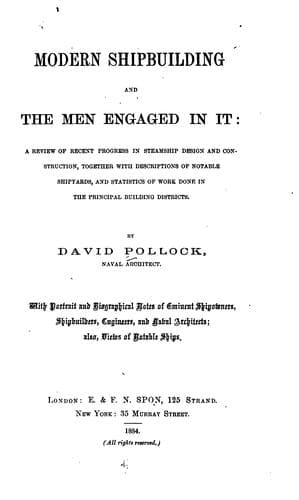
Modern shipbuilding and the men engaged in itPollock, David
History
Modern shipbuilding and the men engaged in it
Pollock, David
Shipbuilding -- Great Britain
In these days of feverish activity in every avenue of business, when
even leisure has come to be observed at a much more accelerated
_tempo_ than formerly, speed in locomotion would seem to be the
first desideratum, not only on shore but afloat as well. In no ocean
service is the truth of this so apparent as in the transatlantic mail
and passenger service, the oldest and most constantly progressive,
and where at the present time, certainly more than at any former
period, the contest for supremacy amongst rival steamship lines
has assumed the form of increased speed and enhanced passenger
accommodation.
The Atlantic service, for these reasons, as well as because it
exemplifies more of the fruits which have rewarded the joint labours
of the engineer and shipbuilder in improving marine propulsion, may
be selected for detailed review. In other ocean services, of course,
the achievements of engineering and shipbuilding skill have also
been made apparent, and in ways, perhaps, which the Atlantic service
does not exhibit. Reference to these will afterwards be made, but
attention will meantime be confined to the service stated, and to
such considerations of the general progress made in ocean navigation
as are necessarily involved in the particular subject.
It is needless, in view of the frequency with which the story of
ocean steam navigation is told, and especially, considering the
scope of the present review, to enter at any length into the details
of early service. The first practically successful transatlantic
steamers were the _Sirius_ and the _Great Western_, the first a
paddle-steamer 170 feet long, 270 horse-power originally constructed
to ply between London and Cork, and the latter, a paddle-steamer, 212
feet long and about 440 horse-power, designed and built expressly for
the transatlantic service. The _Sirius_ left Cork on the 4th April,
1838, and reached New York on the 22nd; the _Great Western_ left
Bristol on the 7th April, three days after the _Sirius_, reaching
New York on the 23rd—the time taken being thus 18 days and 15 days
respectively. The return voyages of these pioneer long-passage
steamers were made in 16 days and 14 days respectively, their
performances at once establishing the superiority of steamers,
commercially and otherwise, over the sailing ships which had
previously for so long been the recognised medium of transit in the
Atlantic passenger trade.
Public-domain text, read in full here on John Shaqi.
Reviews
Reviews
No reviews yet
Be the first to share your thoughts on this work.
Join the Discussion
Join the discussion
Sign in to leave a comment or review.
Sign InorCreate an account