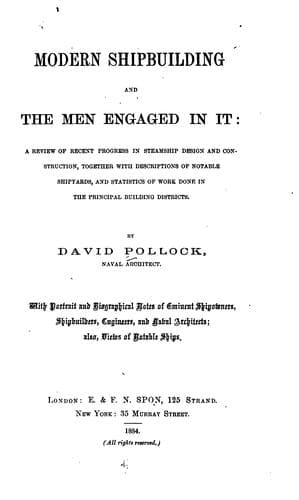
Modern shipbuilding and the men engaged in itPollock, David
History
Modern shipbuilding and the men engaged in it
Pollock, David
Shipbuilding -- Great Britain
The employment of steamships in long voyages and at high rates of
speed, for which, not so long ago, it was generally supposed sailing
ships were only adapted, has been eminently successful. By the
opening of the Suez Canal the passage to China was shortened from
about 13,500 miles to about 9800 miles, that to India from over
10,000 miles to 6000. Although steamers were running to China _via_
the Cape of Good Hope, before the opening of the Canal, and doing the
service most admirably, it is subsequent to that great change, and
indeed quite recently that the most noteworthy advances have been
made in shortening the time occupied on these important services.
The passage is now made by steamers under ordinary circumstances in
less than thirty days, which sailing ships under the most favourable
conditions took three and a half to four months to accomplish. The
average speed attained by the steamers prior to the short route never
exceeded ten knots; steamers now frequently average twelve knots over
the whole distance, except during their passage through the Canal.
The _Stirling Castle_, built in 1882 by Messrs Elder & Co., for
Messrs Skinner & Co.’s China fleet, attained a speed of 18·4 knots on
her official trial. During 1883 she proved herself to be the fleetest
vessel ever engaged in the China tea-carrying trade, arriving in the
Thames several days ahead of the China mails, although the latter
came part of the way overland. The run from Woosung to London was
made in 27 days 4 hours steaming time. Other vessels belonging to
this Company, and vessels of the other lines on this important
service, although not equalling the performances of the _Stirling
Castle_, are exemplifying almost daily the immense superiority of
steamers over sailing ships for regularity and despatch in long
passages.
Public-domain text, read in full here on John Shaqi.
Reviews
Reviews
No reviews yet
Be the first to share your thoughts on this work.
Join the Discussion
Join the discussion
Sign in to leave a comment or review.
Sign InorCreate an account