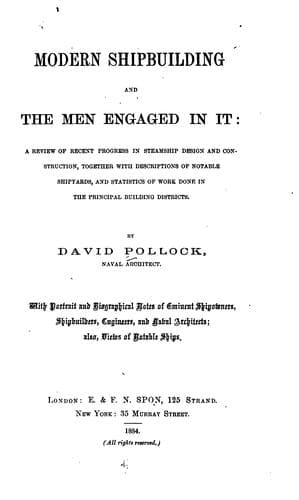
Modern shipbuilding and the men engaged in itPollock, David
History
Modern shipbuilding and the men engaged in it
Pollock, David
Shipbuilding -- Great Britain
Until quite recently the only direct communication with New Zealand
has been by sailing vessels, but the New Zealand Shipping Company
(Limited) and the Shaw, Savill, & Albion Company (Limited) are at
the present moment in the thick of organising monthly services of
high-class modern steamships to the Antipodes. The former Company in
1883 despatched the _Ionic_, which they had chartered, with other
of the White Star steamships, for the purpose. This vessel made the
passage out to New Zealand in 43 days, and home in 45 days, including
stoppage for coaling. Passages of a similar character have been
made by this vessel and others of the Company’s own fleet, three of
which—the _Tongariro_, _Aorangi_, and _Ruapehu_—are splendid new
steel vessels from the stocks of the famous Fairfield yard. The
vessel last named has just made the passage home from Lyttelton, New
Zealand, to Plymouth, in the marvellously short period of 37 days,
20 hours, 40 minutes, steaming time; the time, with detentions,
being about 39 days. The other Company referred to are having
two magnificent steel vessels built by Messrs Denny & Bros., of
Dumbarton, to be named the _Arawa_ and _Tainui_, each of 5000 tons
gross. These vessels are to maintain a sea speed of 12½ knots, the
engines to be fitted representing a noteworthy advance in the line of
economical consumpt of fuel with prolonged terms of steaming.
* * * * *
Between 1875 and 1882 the number of steamers having ocean speeds of
13 knots and upwards, increased from twenty-five to sixty-five. Of
these there were only ten—previous to 1875—of 14 knots speed and
upwards, whereas at the beginning of 1882 there were twenty-five of
this character. During the years 1882 and 1883 alone the increase
in the number of such vessels has been almost double that for the
previous period named. The highest speed previous to 1875 did not
exceed 15 knots, now there are numerous vessels with speeds exceeding
17 knots, several even approaching 18 knots, while in one or two
cases the speed attained—under favourable circumstances probably—is
stated to have been considerably over 18 knots, the Guion Liner
_Oregon_, indeed, reaching the round figure of 20 knots.
Viewed purely from the point of view of the sea voyager, such results
are alike remarkable and gratifying, whilst considered in their
technical and commercial aspects they also call for admiration. It
is questioned, however, whether in most cases the attainment of
great speed has been accompanied with corresponding or proportionate
advance in other matters with which vital progress is concerned.
Commercially, it is of the utmost importance that increase of speed
and power should be achieved, with the least possible weight of
machinery, water, and fuel to be carried; with the least possible
expenditure of fuel; with safety and efficiency in working; with low
wear and tear, and cheapness of maintenance.
Public-domain text, read in full here on John Shaqi.
Reviews
Reviews
No reviews yet
Be the first to share your thoughts on this work.
Join the Discussion
Join the discussion
Sign in to leave a comment or review.
Sign InorCreate an account