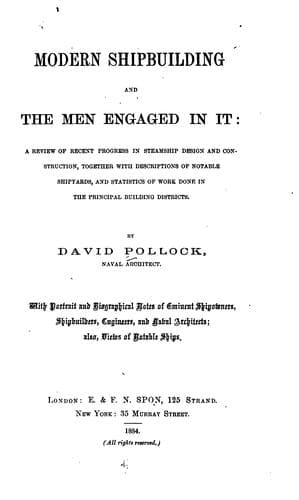
Modern shipbuilding and the men engaged in itPollock, David
History
Modern shipbuilding and the men engaged in it
Pollock, David
Shipbuilding -- Great Britain
Particular occurrences within recent years have without doubt played
a large part in bringing about this more general and intelligent
appreciation of such matters. Some maintain, indeed, that it is
only under pressure of circumstances that anything like proper
regard for fundamental principles has obtained hold among mercantile
shipbuilders. This remissness, even admitting it to be true, is the
more natural and excusable in private commercial concerns, when it
is considered that the bulk of progress made, even in Admiralty
quarters—where ships take several years each to build, and there
is more time for scientific investigation and experiment than is
possible in mercantile work—is more attributable to the awakenings
which have followed upon great disasters than to the natural
improvement of ordinary practice. The terrible loss of the _Captain_
in September, 1870, for example, by which 500 lives were sacrificed,
led to a fuller recognition of the necessity for exact experiment
and calculation to determine thoroughly the conditions of stability
for war vessels; and many war-ships then under construction at the
dockyards—particularly those of the low freeboard type—were altered
in consequence, for the purpose of adding to their safety. The
capsizing of the _Eurydice_ off the Isle of Wight in March, 1878;
the mysterious and mournful loss of her sister ship the _Atalanta_
in 1880; the explosion on board the _Thunderer_ in 1876, by which 45
lives were lost, and the still more calamitous case of the _Doterel_
in April, 1881, by which the ship and 148 lives were destroyed,
are all instances of calamity, the causes of which have formed the
subject of official inquiry, all in their turn teaching important
lessons and yielding subsequent benefits not easily calculable.
Recent occurrences of a very calamitous nature in connection with
merchant ships—some of which will be more explicitly referred to
further on—have been attended with similarly mournful, but, it may
be added, with similarly beneficial results. These disasters and
the resulting inquiries have shown pretty conclusively that the
knowledge of a vessel’s stability and other vital qualities possessed
by ship’s officers is often meagre and erroneous; and that far too
little attention is usually paid to a vessel’s technical qualities
by shipowners or their advisers. They have also tended to prove that
exact knowledge of the principles of ship design, and observance of
scientific method in their construction, are not yet sufficiently
prevalent or thorough in mercantile shipyards.
* * * * *
Public-domain text, read in full here on John Shaqi.
Reviews
Reviews
No reviews yet
Be the first to share your thoughts on this work.
Elsewhere in the archive
Join the Discussion
Join the discussion
Sign in to leave a comment or review.
Sign InorCreate an account