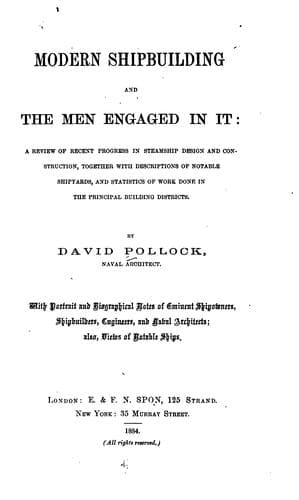
Modern shipbuilding and the men engaged in itPollock, David
History
Modern shipbuilding and the men engaged in it
Pollock, David
Shipbuilding -- Great Britain
Rankine appears to have become specially interested in the problems
connected with ship design, after he became Professor of Civil
Engineering at Glasgow University in 1855. Conjointly with Mr Isaac
Watts, late Chief Constructor of the Navy, and formerly a student of
the first School of Naval Architecture; Mr F. K. Barnes, now Surveyor
of Dockyards, and Chief Constructor of the Navy, and a distinguished
student of the second school; and the late Mr J. R. Napier, a member
of the famous Clyde shipbuilding firm, Prof. Rankine produced in 1866
“Shipbuilding: Theoretical and Practical.” This valuable treatise was
edited, and for the most part written, by Prof. Rankine, and provides
a complete system of information on all branches of shipbuilding
and marine engineering, although subsequent progress in certain
departments of naval science has made a new edition desirable. The
work is also distinguished for its enunciation of several theories
connected with the resistance and propulsion of vessels by Prof.
Rankine, which have become the accepted basis of modern practice.
Of these the mechanical theory of the action of propellers, and
the stream-line theory of resistance, are the best known. His
investigations and writings on the latter subject were most ably
supplemented and confirmed by Mr Froude, whose beautifully-contrived
model experiments, coupled with his discovery of the law by which
such experiments can be made to afford reliable data for the
resistance of full-sized vessels, have laid the profession under even
a heavier load of indebtedness.
This, however, was not the only work of investigation and experiment
with which Mr Froude actively and inseparably identified himself.
Taking up a subject which many authorities before him had studied and
written upon with but little success—that of the phenomena of wave
motion and the oscillation of ships in a seaway—he propounded and
demonstrated at the Institution of Naval Architects in 1861, after
much careful thought and experiment, a theory with respect to it
which at that time was entirely new and striking, but which has since
been firmly established as the sound one.
Public-domain text, read in full here on John Shaqi.
Reviews
Reviews
No reviews yet
Be the first to share your thoughts on this work.
Elsewhere in the archive
Join the Discussion
Join the discussion
Sign in to leave a comment or review.
Sign InorCreate an account