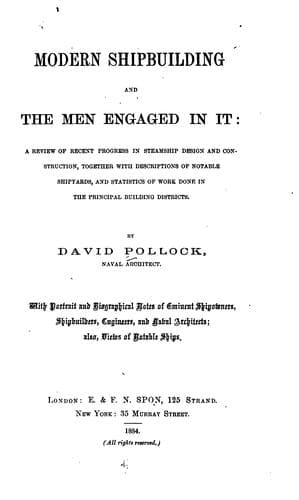
Modern shipbuilding and the men engaged in itPollock, David
History
Modern shipbuilding and the men engaged in it
Pollock, David
Shipbuilding -- Great Britain
Another name that must be linked with those already mentioned in
connection with the change from wood to iron in shipbuilding, and
with the new conditions imposed by the transition from sail to steam,
is that of the late Mr John Scott Russell, already referred to at the
beginning of this work. In the fields of inquiry so largely opened
up at the period referred to, Mr Russell was a most distinguished
worker. His advocacy and adoption in practice of special structural
principles, as illustrated not only in the _Great Eastern_ but in
other vessels, has influenced subsequent practice incalculably, and
by his persevering investigations upon the resistance of vessels,
and the “wave-line” theory he advanced, as well as by his inquiry
into the characteristics of wave motion, he laid designers of that
period and subsequent investigators under great indebtedness. His
contributions to the literature of the profession—notably his _magnum
opus_, entitled “Modern System of Naval Architecture”—and the large
share he subsequently took in the deliberations of the Institution of
Naval Architects, and of other societies concerned with shipbuilding
and engineering, enhance that indebtedness and remain as permanent
records of his skill and originality.
Approaching the period with which this review is more particularly
concerned, reference must now be made to the valuable labours of two
eminent men, whose loss the profession has had to mourn within recent
years. These are the late Professor Macquorn Rankine and the late Mr
William Froude, neither of whom was by profession a naval architect,
yet both of whom were led by love of the subject to give their
matured experience as civil engineers and mathematical experts to the
promotion of knowledge in this domain.
Public-domain text, read in full here on John Shaqi.
Reviews
Reviews
No reviews yet
Be the first to share your thoughts on this work.
Elsewhere in the archive
Join the Discussion
Join the discussion
Sign in to leave a comment or review.
Sign InorCreate an account