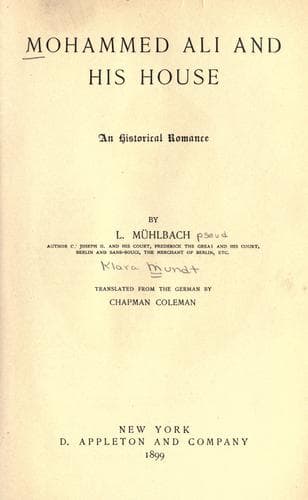
Egypt -- History -- Mohammed Ali, 1805-1849 -- Fiction; Muhammad Ali Basha, Governor of Egypt, 1769-1849 -- Fiction
Suddenly the music of the trumpet, cymbal and fife, and the roll of
the drum, breaks in upon and mingles with these tumultuous cries.
With warlike music the company of soldiers from the nearest city
marches into Praousta, in accordance with the command given by the
governor to his captain.
The men have been on the march all night, and now enter the village
in the broad light of day, with their band playing.
The military music rings out so loud and clear that the cries of
lamentation are no longer heard. The crowd stand still and gaze at
the gaudily-attired men who are marching into Cavalla. The
tschorbadji is standing with his distinguished guest, Cousrouf
Pacha, in the court-yard of the palace. He has requested him to be
present at the reception of the soldiers. The pacha's countenance
and bearing are unchanged--all haughtiness and dignity--only his
cheeks are paler and his glance more threatening than usual. As he
now turns toward the gate of the court-yard, Mohammed Ali, the
boulouk bashi, appears for the first time, attired in his handsome,
glittering uniform, advancing with his company toward the palace. On
the governor's left stands his son Osman, who has risen from his
couch, overcoming for the moment his weakness and ill-health in
order to participate in the triumph of witnessing Mohammed Ali lead
his company, as boulouk bashi, for the first time.
Yes, there comes Mohammed Ali, marching at the head of his company,
to the sound of the martial music. He holds his sword uplifted in
his right hand, and salutes the governor as he approaches by
lowering its point to the ground with a deferential glance. He
recognizes his friend, and Osman joyously returns the greeting.
Mohammed seems to him entirely changed at this moment, his figure
taller and more powerful. His countenance is manly and joyous, his
eyes sparkle with a mysterious fire, a smile plays about his lips,
and his whole bearing is firm and commanding.
It is not Osman alone who sees this change. Cousrouf Pacha has also
observed it. His countenance darkens. He compresses his lips as if
to repress a curse that is struggling for utterance. Yet he retains
his air of indifference and grave countenance, though his cheeks
grow a shade paler, and his brow somewhat darker.
The band plays a lively air. Mohammed conducts his soldiers before
the eyes of the governor and his guest through a series of movements
and evolutions which he has long since practiced in secret. As they
now advance toward him, "Right about, halt!" resounds Mohammed's
word of command; and his soldiers stand there like a wall.
"Well done," said Cousrouf Pacha, with a gracious inclination of the
head. He then added in a loud voice, in order that Mohammed should
hear him: "You see, governor, street boys can watch soldiers
exercising to some purpose. Mohammed has not stared at them on the
street in vain."
Public-domain text, read in full here on John Shaqi.
Reviews
Reviews
No reviews yet
Be the first to share your thoughts on this work.
Elsewhere in the archive
Join the Discussion
Join the discussion
Sign in to leave a comment or review.
Sign InorCreate an account