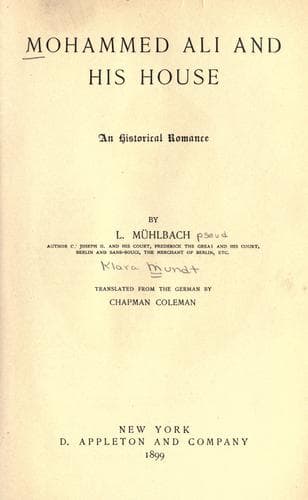
Egypt -- History -- Mohammed Ali, 1805-1849 -- Fiction; Muhammad Ali Basha, Governor of Egypt, 1769-1849 -- Fiction
He turns and leaves the court-yard, repairs to his private
apartments, and calls the two eunuchs who had held the fruitless
watch at the gate the previous night.
"When the soldiers have left the court-yard, twelve of their number
will be placed at your disposal. Let them load their muskets and
unsheath their swords. Then go to Praousta, to the sheik's house,
and demand the restoration of my slave. Demand it in my name. If her
father refuses, search the house and every place connected with it.
Break open the doors if he refuses to unlock them. If you do not
find her there, search the other houses of the village. I must have
her! If you do not find her to-day, then find her to-morrow or the
next day. I will allow you a week's time in which to get possession
of this runaway slave. If you do not return her, your heads shall
fall! Remember that! Stop, one thing more: observe and watch the new
boulouk bashi. Select some of my servants to follow him day and
night, and to observe every thing he does, yet without letting him
become aware of it, for he is a shrewd lad and a daring one, too.
Now, you can go."
While the company is still standing drawn up in the court-yard, the
tschorbadji beckons Mohammed Ali to his side, and enters the palace
with him.
"Mohammed, it is evident that you will become a brave and efficient
soldier. You have courage; now learn to control your anger, to
govern yourself, and then you will know how to command others. See,
this purse filled with gold-pieces is the captain's salary for three
months, which I pay in advance, as the young boulouk bashi will have
to incur some necessary expenses, and will therefore be glad to
accept a payment in advance."
Mohammed thanked the governor, and received the first salary of his
new dignity with perfect composure, though a sudden sparkling in his
eyes indicated how much he rejoiced over it.
Osman, however, can read his friend's countenance well. As the
governor turns away, Osman throws his arms around Mohammed's neck
and whispers in his ear: "You stand there radiant like a hero, and
all the bliss of the world and of love, too, is reflected in your
countenance. O Mohammed, father says you should learn to control
yourself, and I am satisfied you can. When my friend is harassed
with sorrow and care his countenance bears no evidence of it, but
happiness is not to be repressed and driven back to the heart in
this way. It illumines the face of man like the sun. But I warn you,
Mohammed, it is sometimes dangerous to let one's countenance shine
so. It easily awakens suspicion in the breast of an enemy, and he
meditates revenge. Beware! Beware!
Mohammed regards his friend as though he did not understand him.
"What do you mean, Osman?"
"Nothing, nothing at all, Mohammed, except that it is sometimes
dangerous to allow one's happiness to be observed. Bear this in
mind, my friend, and draw a veil over your radiant countenance."
CHAPTER IX
WHERE IS SHE?
Public-domain text, read in full here on John Shaqi.
Reviews
Reviews
No reviews yet
Be the first to share your thoughts on this work.
Elsewhere in the archive
Join the Discussion
Join the discussion
Sign in to leave a comment or review.
Sign InorCreate an account