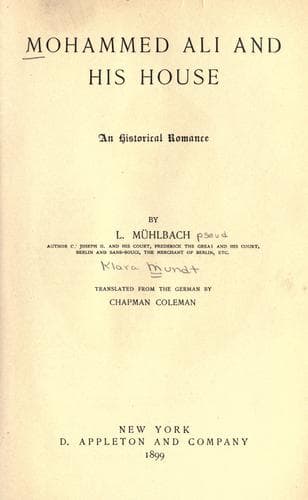
Egypt -- History -- Mohammed Ali, 1805-1849 -- Fiction; Muhammad Ali Basha, Governor of Egypt, 1769-1849 -- Fiction
"Nothing could resist the descendant of the prophet, and Mahadi
Obeidallah erected his throne in Alexandria. The conquest of Egypt,
begun by him, was finished by his grandson, Moez. He brought a
hundred thousand men, commanded by his vizier Jauhar, to Alexandria,
and marched with them through the desert toward the great city of
Fostal, which Caliph Amrou had built.
"Near this great city, Jauhar founded another with splendid walls
and palaces, and he called it El-Kahera--that is, the--Victorious.'
Proudly, victoriously, beside the old city of Fostal, arose the new
city of El-Kahera, the wondrous city! Moez sat enthroned there in
the midst of his realm, and he founded in El-Kahera, the Victorious,
the dynasty of the Fatimite caliphs; for Fatima, the daughter of the
prophet Mohammed, had married Ali, who was the head of the house
from which Moez and Jauhar descended.
"The new city, El-Kahera arose quickly, and soon became the model
for all that was beautiful in the arts and sciences in Egypt. The
haughty Bagdad, once so mighty, sank into the dust before her.
"But the Fatimites were neither wiser nor more fortunate than the
Abbassites, of whom I told you yesterday, had been. The people could
not love them, for the Fatimites ruled tyrannically, and knew
nothing of pity and love; and the religion of the prophet, which
teaches that we should love and do good to our fellow-men, they
practised with their tongues only, but not in reality. They thought
it sufficient to be able to call themselves descendants of the great
prophet, without imitating him in his good works.
"At last one of them even dared to proclaim himself the prophet. His
name was Hakem. To him it did not seem enough to be the descendant
of Mohammed, of our great prophet--he wished to be king and prophet
himself. He desired to found a new religion, and, because the
inhabitants of El-Kahera would not bow down before him in the dust,
and abandon their prophet, Mohammed, for his sake, he caused the one
half of the beautiful city of El-Kahera, the Victorious, to be laid
in ashes, and he allowed his wild hordes to plunder and rob the
other half. He rejoiced in this, and imagined Allah would be
contented. He said, too, that Allah conversed with him each day, and
gave him instructions with his own lips. It was for this purpose
that he went daily into the mountains of Mokatan, which rise on the
banks of the Nile, near the city; and there he, a second Moses,
communed, as he declared, with Allah.
"But one day he did not return from the mountains, and when his
janizaries sought him they found him lying dead on the ground,
pierced with daggers.
"The Fatimites had ruled over Egypt for two hundred years. Their
glory was now at an end, and Allah sent the unbelievers as a scourge
to punish those who had dared to set themselves above the prophet,
to punish the sons of Hakem who had declared himself to be the
prophet.
Public-domain text, read in full here on John Shaqi.
Reviews
Reviews
No reviews yet
Be the first to share your thoughts on this work.
Join the Discussion
Join the discussion
Sign in to leave a comment or review.
Sign InorCreate an account