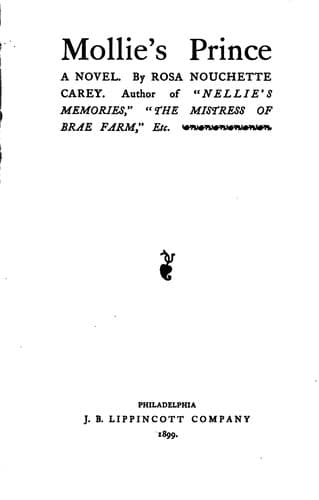
England -- Social life and customs -- 19th century -- Fiction; Love stories; Twins -- Fiction; Young women -- Fiction
"Yes; and then we will all go to the station with you. But oh, Wave, how
I shall hate Monday mornings! I shall never feel cheerful until
Wednesday is over;" but Waveney would not hear of this--she preached
quite a little homily on the duty of cultivating cheerfulness; but her
eloquence died a natural death when she saw Mollie nod, and ten minutes
later they were both asleep.
It was a free morning with Mr. Ward, and he was not at all surprised
when Waveney invited him to take a prowl.
"Won't Mollie prowl, too?" he asked, as he noticed her wistful
expression. But Waveney shook her head.
"Mollie was an idle girl yesterday," she remarked, severely; "she must
stay in and finish her menu card. There, you shall have the Black
Prince's flowers to console you;" and Waveney placed them on the
painting-table. "'Sweets to the sweet'--they are as much yours as mine,
Mollie." Then Mollie blushed a little guiltily. More than once the
thought had passed through her mind--how nice it would be if she had a
Monsieur Blackie to bring her hot-house flowers. For Mollie was very
human, and certainly
"A creature not too bright and good,
For human nature's daily food,"
and she had her girlish weaknesses. Not that she envied Waveney her
flowers; but, as she sniffed them delightedly, her imagination conjured
up numberless bouquets for Miss Mollie Ward; only the donor must be tall
and fair, not a little dark Frenchified artist like Monsieur Blackie.
Waveney chatted to her father quite gaily until they had crossed the
lime avenue, and had reached the landing-stage. Then they walked a
little way down the embankment, and sat down on a bench under a shady
tree. It was still early, and there were few passengers; only now and
then a river steamer passed, churning the blue water into light, foamy
waves. Two or three children were bowling their hoops, followed by a
panting pug.
Waveney cleared her voice rather nervously; then she slid her hand into
her father's arm. Everard could see the worn little glove fingers on his
coat sleeve; he stared at the white seams dreamily as he listened. He
was a man who noticed trifles; there was a feminine element in his
character. That little shabby grey glove appealed to him forcibly.
"Father, dear, I have something to tell you--that is why I did not want
Mollie to come; it is so much easier to talk about difficult things to
only one person." Waveney's voice was not as clear as usual. "Will you
promise to listen, dearest, without interrupting me?" Mr. Ward nodded,
but his face was a little grave. What could the child have to say?
Waveney told her story very fully. She gave her father a description of
the Red House and Fairy Magnificent, but she never mentioned Miss
Harford's name; she spoke of them vaguely as "the ladies."
"And you have settled all this without speaking to me?" and there was a
hurt look on Mr. Ward's face. Then Waveney nestled closer to him.
Public-domain text, read in full here on John Shaqi.
Reviews
Reviews
No reviews yet
Be the first to share your thoughts on this work.
Join the Discussion
Join the discussion
Sign in to leave a comment or review.
Sign InorCreate an account