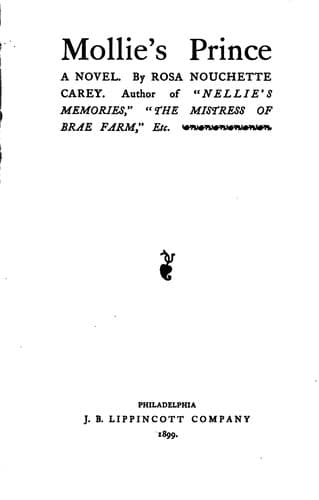
England -- Social life and customs -- 19th century -- Fiction; Love stories; Twins -- Fiction; Young women -- Fiction
Waveney sat on the bench feeling very forlorn and deserted until her
father came back to her. He had evidently pulled himself together, for
he looked at her with his old kind smile, though perhaps his lips were
not quite steady.
"Come, little girl, don't fret," he said, tenderly. "Least said is
soonest mended, and we must just go through with it."
"But, father, are you sure you do not mind?" she returned, eagerly. "We
are very poor, but I would rather please you, dear, than have ever so
much money--you know that, do you not?"
Waveney's eyes were full of tears, and her little hands clasped his arm
appealingly. Mr. Ward's laugh was a trifle husky.
"I know I have two good children," he returned, feelingly. "Look here,
my child, things have got a little mixed and complicated, and I find it
difficult to explain matters. It is my 'poverty and not my will
consents,' don't you know--and we must just pocket our pride and put a
good face on it."
"Do you mean that I am to go to Miss Harford? Are you very sure that you
mean that, dad?"
"Yes, certainly"--but his face clouded. "Did you not tell me that Miss
Althea suffered with her eyes, and needed a reader and companion? We
were good friends once, so why should I put an affront on her by
refusing her my daughter's services?"
Waveney sighed; she felt a little oppressed: her father took a
reasonable and practical view of the case, but his voice was
constrained; he was a proud man, and at times he chafed sadly at his
limitations. He could not forget that he had come of a good old stock;
he used to tell his girls to carry their heads high, and not allow
themselves to be shunted by nobodies.
"Your mother was a gentlewoman," he would say, "and your
great-grandmother had the finest manners I ever saw; she was a Markham
of Maplethorpe, and drove in a chariot and four horses when she went to
the county ball. It was your grandfather who ruined us all; he
speculated in mines, and so Maplethorpe was sold. I saw it once, when I
was a little chap: I remember playing on the bowling green."
Everard Ward thought he was doing his duty in teaching his girls to
consider themselves superior to their neighbours, but sometimes Waveney
would joke about it. She would come into the room with her little nose
tip-tilted and her head erect, and cross her mittened hands over her
bosom. "Am I like my great-grandmother Markham?" she would say. "Stand
back, Mollie; I am going to dance the minuet;" and then Waveney would
solemnly lift her skirts and point her tiny foot, and her little
performance would be so artless and full of grace that Mr. Ward would
sit in his chair quite riveted.
"Father, I wish you would tell me how you first came to know the Misses
Harford?" asked Waveney, rather timidly.
Mr. Ward had relapsed into silence, but he roused himself at the
question.
Public-domain text, read in full here on John Shaqi.
Reviews
Reviews
No reviews yet
Be the first to share your thoughts on this work.
Join the Discussion
Join the discussion
Sign in to leave a comment or review.
Sign InorCreate an account