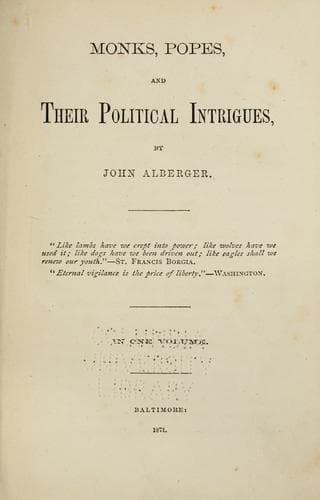
Monks, Popes, and their Political IntriguesAlberger, John
History
Monks, Popes, and their Political Intrigues
Alberger, John
Catholic Church; Catholic Church -- United States; Church and state
Whatever plausibility the creed and ritual of the Catholic church may
throw around her religious pretensions, the fact is undeniable that she
is a temporal power, claiming to be the only legitimate sovereignty on
earth, and the right to reduce all governments, by fair or foul means,
under her absolute authority. The pope, the head of this unlimited
monarchy, is a political prince; his capital is the city of Rome, and
his domains, until recently, were the States of the Church. According to
a practice observed at the coronation of princes, the pope is invested
with national authority by ascending the Chair of State, and receiving
a headdress emblematical of temporal sovereignty. These symbolical
headdresses were originally garlands, invented by Prometheus in
imitation of the chains which he had worn for the redemption of
mankind, but which in the course of time became applied, by the Uranian
priestesses to decorate themselves and their altars; by lovers, to
adorn the doors of their mistresses: by the devout, to deck the animals
which they devoted to sacrifice; by slave owners, to attract attention
to the slaves whom the exposed for sale; by relatives, to embellish the
corpse of a deceased friend; and finally, in the dark ages, when
they were transformed into a variety of fantastical shapes, profusely
decorated with gold, gems and pearls, and had become associated
with ideas of greatness, power and authority, they were exclusively
appropriated by kings to symbolize the regal authority. In the ninth
century, this practice having become fashionable among the royal
classes, Pope Alexander III., who was elected in 1159, aspiring to
be considered rather as the successor of kings than of a fisherman,
ventured to encircle his sacerdotal mitre with a regal diadem,
emblematical of universal spiritual sovereignty. To this crown Pope
Boniface VIII., elected in 1295, added a second, to symbolize the pope's
universal temporal power; and to this crown Pope Urban V., elected in
1363, added a third, to denote the pope's supreme spiritual and temporal
power over Europe, Asia and Africa. The adoption of these regal emblems
by the holy fathers may seem in the eyes of the profane to represent
not their rights, but their ambition. They claim, however, to have been
moved by the Holy Ghost in adopting their head decorations; but if this
pretension absolves them from the vice of ambition, it limits at the
same time their authority to Europe, Asia and Africa. The Holy Ghost not
having intimated the existence of America in his social intercourse
with the papal monarchs, nor prescribed to them the adoption of a fourth
crown to symbolize their authority over it, it is rational to infer from
these facts that he intended to infer by his silence, that the
popes have no right whatever of exercising any jurisdiction over its
territory. If the pope's regalia have any significance, it is that his
government is restricted to Europe, Asia and Africa; and that he has
Public-domain text, read in full here on John Shaqi.
Reviews
Reviews
No reviews yet
Be the first to share your thoughts on this work.
Elsewhere in the archive
Join the Discussion
Join the discussion
Sign in to leave a comment or review.
Sign InorCreate an account