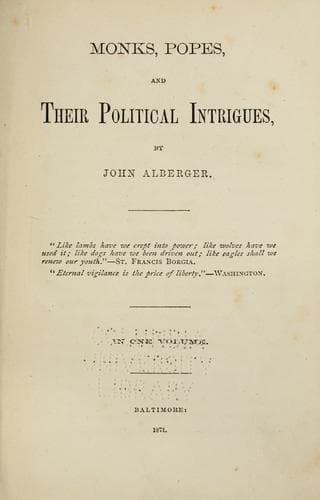
Monks, Popes, and their Political IntriguesAlberger, John
History
Monks, Popes, and their Political Intrigues
Alberger, John
Catholic Church; Catholic Church -- United States; Church and state
no right to exercise either temporal or spiritual authority over any
church, society or institution, on the American continent. But in sight
of the pope's monarchical palace, triple crown; and regal ornaments, the
statue of St. Peter, erected in the seventh century, wearing a simple
mitre, stands scoffing at them in eternal derision.
The pope as an independent sovereign has not only a temporal crown, but
a political banner. This ensign consists of a white flag with a device
of cross-keys; its white color may signify peace; the cross-keys the
possession of earth and heaven; and, conjointly, these emblems may
intimate that there is to be no peace until the claims of the pope to
universal spiritual and temporal sovereignty is acknowledged by all
nations. Apollo, the symbol of the rising sun, and Pluto, the symbol
of the closing day, are represented with keys in their hands, to denote
their office of opening and shutting the gates of day. It is thought by
some that the idea of the papal keys was borrowed from these emblems of
the Pagan Gods. But it was the custom of a conquered city to present to
the victor the keys of its gates, through its officials, in token of the
submission of the inhabitants to his authority. In conformity with
this ancient custom, it is affirmed by the popes that Pepin, King of
France, after he had wrested the Exarcate from the possession of the
Lombards, presented the keys of the subjugated cities to the Holy See on
the tomb of St. Peter. They assert also, that Charlemagne presented the
pope with a banner, and authorized him to unfurl it in the cause of the
church. But if the story of Pepin's gift is as empty as the tomb of St.
Peter, at Rome, is and always has been, of the corpse of the apostle;
and if Charlemagne's donation of cities, most of which he never
possessed, and the remainder of which he governed as his own with the
most jealous scrupulosity until the day of his death, it is difficult to
perceive how the popes, by virtue of these gifts, can have any claim to
either keys or banners.
The pope, as an independent sovereign, has also a national cabinet. His
privy council is the college of cardinals; his minister of internal and
foreign affairs is the cardinal secretary; his viceroys are the legates
and nuncios which he accredits to foreign powers; his governors and
lieutenant-governors are the Catholic bishops and archbishops, which are
located in different parts of the world; and his ministers of finance
and police are the priests of different grades and orders. The civil
offices of the papal monarchy have always been filled by members of the
sacerdotal orders, and disposed of by the holy father for money.
Public-domain text, read in full here on John Shaqi.
Reviews
Reviews
No reviews yet
Be the first to share your thoughts on this work.
Elsewhere in the archive
Join the Discussion
Join the discussion
Sign in to leave a comment or review.
Sign InorCreate an account