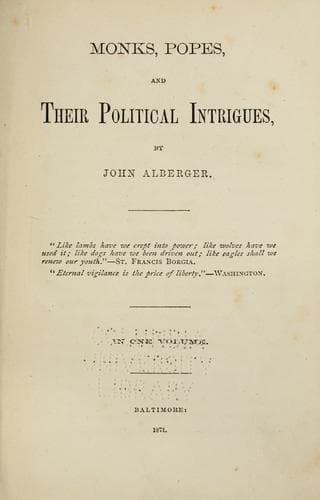
Monks, Popes, and their Political IntriguesAlberger, John
History
Monks, Popes, and their Political Intrigues
Alberger, John
Catholic Church; Catholic Church -- United States; Church and state
The papal military organizations have been of the most formidable
description. The Dominican Knights, the Teutonic Knights, the Knights
of St. John, and the Knight Templars, instituted for the defence
and propagation of Catholicism by the force of arms, were skilfully
organized and rigorously disciplined. They assumed the vows of celibacy,
poverty and unconditional obedience. They were interdicted, by the terms
of their charter, from acknowledging any protector but the pope, and
were made independent of any other authority. Upon becoming initiated
into their orders, the pope absolved them from all human obligations,
and they were required to sunder all human ties. They enjoyed all the
immunities and privileges of the religious orders; and in conjunction
with them formed a standing army of three hundred thousand men, fully
equipped for war, exclusively devoted to the pope's interest, and ready
at his call to serve him by land or sea.
As an independent sovereign the pope has a national revenue. This
revenue is domestic and foreign. From official reports the pope's
domestic revenue, in 1853, amounted to 13,000,000 florins; his
foreign revenue is not publicly known. In the dark ages half of the
ecclesiastical revenues of Europe flowed into the church treasury at
Rome; but at present the various streams of wealth destined for the
church, are diverted to convenient localities, situated in different
parts of the world, to be disbursed according to regulations prescribed
by the holy father. As the subject is somewhat curious, we are tempted
to inquire into some of the sources of the papal revenue.
One source of the pope's revenue is the sale of indulgences. St. Peter's
Church, at Rome, which cost 45,000,000 crowns, was chiefly built from
the proceeds of this species of traffic. William Hogan furnishes some
singular facts respecting this ingenious device, by which the church
accommodates the wishes of the members in the commission of sin, to her
pecuniary advantage. He says:
"They (the pope and the propagandi) resolved that indulgences should, in
the future, be called _scapulus_, and thus piously enable all Catholic
priests and bishops to swear on the Holy Evangelists that no indulgences
were sold in the United States..... The scapula costs the purchaser
one dollar. The priest who sells it tells him that in order to make it
thoroughly efficacious, it is necessary that he should cause some masses
to be said.... I may safely say that, on an average, every scapula sold
in the United States costs at least five dollars."--_Synopsis, pp_. 176,
177.
Public-domain text, read in full here on John Shaqi.
Reviews
Reviews
No reviews yet
Be the first to share your thoughts on this work.
Elsewhere in the archive
Join the Discussion
Join the discussion
Sign in to leave a comment or review.
Sign InorCreate an account