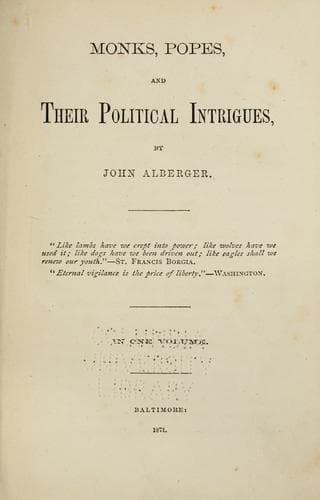
Monks, Popes, and their Political IntriguesAlberger, John
History
Monks, Popes, and their Political Intrigues
Alberger, John
Catholic Church; Catholic Church -- United States; Church and state
As an independent sovereign the pope has an imperial court. In the
grades of this court he himself enjoys the first rank, being placed
on an equality with God, and in some respects above him. The cardinals
stand next to princes; they wear a purple mantle, the emblem of royalty;
formerly they ranked in Christendom equal with kings, preceded princes
of blood, and sat on the right of kings, or near the throne. The
generals of the Catholic orders, the abbots, archbishops, bishops
and priests, consider their titles as royal, and maintain that in
consideration of them they should be exempted from the jurisdiction of
civil magistrates.
As an independent sovereign the pope has the power to issue absolute
decrees. The papal bulls, apostolic briefs, and encyclical letters,
are the exercise of sovereign power. From the despotic tone of these
documents, sometimes moderated by fear, but never from inclination,
the pope evidently claims the right of interfering not only in the
ecclesiastical, but also in the political affairs of all nations.
As an independent sovereign the pope has a system of jurisprudence
and administrative justice. The canonical law by which he governs his
monarchy consists of the _Concordantia Discordantium_ or _Decretium
Gratiani_; the _Decratales Gregorii Noni_; the _Liber Sextus_, by
Boniface VIII; the _Extravagantes Johannis XXII_; the _Extravagantes
Communes_, and the _Clementinus_; all of which are known under
the general name of _Cor-pus Juris Canonica_; and all except the
_Extravagantes_ have the full authority of law. The papal system of
administrative justice consists of a chief court, a civil court, and an
apostolical court. The apostolical court regulates the pope's domains
and collects the taxes. The members of the court are always bishops, and
the presiding officer is generally a cardinal.
As an independent sovereign the pope has exercised the governmental
prerogative of coining money. The papal coins have various devices. They
all have the cross-keys; most of them the triple crown; and some of them
are inscribed with the word _Dominus_.
As an independent sovereign the pope has always maintained, when
possible, an army and a navy. Pope Clement VIII. elected in 1523, raised
an army of regulars and volunteers of thirty thousand foot and three
thousand cavalry. Pope Leo IX. commanded an army consisting of Italian
volunteers, several bands of robbers, and seven hundred Suabians. Pope
Alexander VI. at the head of a powerful army conquered Bologna, Ancona,
Ravenna and Ferrara. After the return of the pope to Rome from Avignon,
in 1577, a standing army was formed consisting of cavalry and infantry.
Public-domain text, read in full here on John Shaqi.
Reviews
Reviews
No reviews yet
Be the first to share your thoughts on this work.
Elsewhere in the archive
Join the Discussion
Join the discussion
Sign in to leave a comment or review.
Sign InorCreate an account