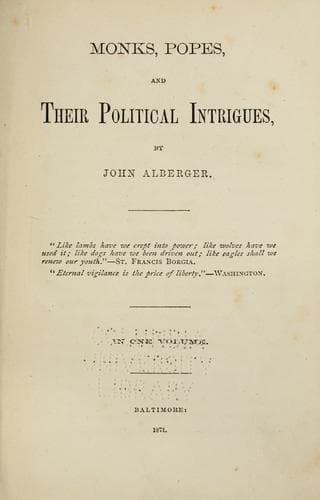
Monks, Popes, and their Political IntriguesAlberger, John
History
Monks, Popes, and their Political Intrigues
Alberger, John
Catholic Church; Catholic Church -- United States; Church and state
We have now sketched the pope's temporal monarchy, which has its seat
in Rome, and its subjects in every part of the world. He claims to be
invested by divine right with supreme sovereignty over earth, heaven
and hell. To question the legitimacy of this claim is condemned, and has
been punished as blasphemous by his authority. Joseph Wolf, of Halle,
a Jew who had been converted to the Catholic faith, was, while studying
divinity at the _Seminarium Romanum_, imprisoned for blasphemy for
having expressed a doubt of the pope's infallibility. Fra Paola, who had
expressed in a private letter that so far from coveting the dignities
of Rome he held them in abomination, and who had advocated liberty in a
dispute which had occurred between the pope and the Venitian government,
was summoned to Rome to answer for his criminal assertions and conduct;
and though acquitted of the allegations preferred against him, narrowly
escaped the assassin's dagger.
But the "More than God," the Pope, is a very jealous "more than God."
He allows no master to stand between him and his subjects. His authority
over mind and body must be direct, and all influences or institutions
that obstruct it must be annihilated.. Hence Cardinal Ballarmine, the
distinguished papal controversialist, who was so devout a Catholic that
when he died he bequeathed one half of his soul to Jesus Christ and the
other half to the Virgin Mary, provoked the censure of the holy father
by asserting in a publication that the pope's influence in temporal
matters was not direct but indirect. As husbands obstruct the direct
influence of popes on wives, parents on children, and friends on
friends, he would nullify the conjugal, parental, filial and social
relations. Hence in a canon of the Council of Trent, he pronounces a
curse on all who say that marriage is preferable to celibacy. Should the
prompting of the social instincts be too strong to be repressed by the
terrors of canonical anathemas, and should they in natural indifference
to them still create the bonds, connections, and institutions of
friendship and families, he has a clerical machinery skilfully adapted
to moderate their influences and reciprocities, and to maintain the
predominence of his direct authority. Michelet, the philosophical
historian and celebrated controversialist, in a work entitled "Priests,
Women and Children," has explained the ingenious method by which this
object is effected. By separating as much as possible the husband
from the wife, and the children from their parents, the direct papal
influence, through the priest, is exerted on the isolated husband
abroad, on the lonely wife at home, and the defenceless children in
nunnery schools and Catholic asylums. Examples of a similar policy are
portrayed by Eugene Sue, a Catholic, in his "Wandering Jew." The logical
consequence of the dogma of the pope's direct authority has, in fact,
made the Catholic church a "free love" institution. Chastity and
Public-domain text, read in full here on John Shaqi.
Reviews
Reviews
No reviews yet
Be the first to share your thoughts on this work.
Elsewhere in the archive
Join the Discussion
Join the discussion
Sign in to leave a comment or review.
Sign InorCreate an account