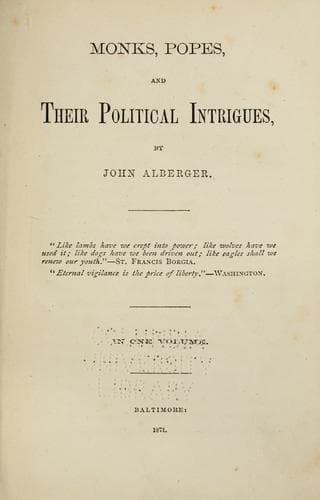
Monks, Popes, and their Political IntriguesAlberger, John
History
Monks, Popes, and their Political Intrigues
Alberger, John
Catholic Church; Catholic Church -- United States; Church and state
marriage she tolerates because she cannot do otherwise; but in the lives
of her monks, her priests, her popes, and her saints, she as practically
ignores as she consistently hates them.
The jealous claim of the pope to a direct influence on the mind of his
subjects, has unavoidably made the church an inveterate enemy of human
slavery. The pope hates slavery, not because he wishes men free, but
because he wishes to exercise a direct authority over their minds. The
master nullifies the pope's influence on the slave, and therefore he
wishes him removed. No influence is equal to that of a master. The whip
he holds over the back of his slave, and the power he has over his life,
annihilates all other influences. Hence the Catholic church has always
been opposed to slavery. Guizot remarks, respecting feudal slavery: "It
cannot be denied, however, that the church has used its influence
to restrain it; the clergy in general, and especially several popes,
enforced the manumission of slaves as a duty incumbent on laymen, and
loudly enveighed against keeping Christians in bondage."--(Gen. Hist.,
Lect. VI., p. 132). Pope Pius II., in 1462, in a letter addressed to the
bishops of Eubi; Pope Paul III., in 1537, in his apostolic letter to the
cardinal bishops of Toledo; Pope Urban VII., in 1590, in an apostolic
letter to the Collector Jurium of the apostolic churches of Portugal;
Pope Benedict XIV., in 1731, in his apostolic letter to the clergy of
Brazil; and Pope Pius VII., in his official address to his clergy, all
denounced the traffic in blacks, and demanded that every species of
slavery should cease among Christians. Pope Gregory, in his apostolic
letter of 1839 says: "We, then, by virtue of our apostolic authority,
censure all the aforesaid practices as unworthy the Christian name,
and by that same authority we strictly prohibit and interdict any
ecclesiastic or layman from presuming to uphold, under any pretext or
color whatever, that same traffic in blacks, as if it were lawful in
its nature, or otherwise to preach, or in any way whatever publicly or
privately to teach in opposition to these things which we have made the
subject of our admonition in this our apostolic letter." We are
aware that African slavery owes its origin to a Catholic priest, who,
perceiving that the demand for laborers in the West India was likely to
subject the Indians to bondage, suggested as a less wrong that negroes
should be purchased of the Portuguese settlements in Africa, and held as
slaves for life; but whatever were his private opinions respecting the
propriety of African slavery, his church has never recognized it as
legal.
Public-domain text, read in full here on John Shaqi.
Reviews
Reviews
No reviews yet
Be the first to share your thoughts on this work.
Elsewhere in the archive
Join the Discussion
Join the discussion
Sign in to leave a comment or review.
Sign InorCreate an account