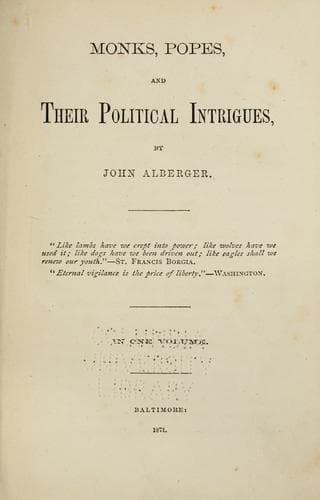
Monks, Popes, and their Political IntriguesAlberger, John
History
Monks, Popes, and their Political Intrigues
Alberger, John
Catholic Church; Catholic Church -- United States; Church and state
The reason assigned for the bestowal of this magnificent donation was
gratitude on the part of Constantine, for having been cured of leprosy
through the administration of the rite of baptism at the hands of Pope
Sylvester. But it is historically established that Constantine did not
receive the rite of baptism until a late hour in his last sickness; that
when he did receive it, it did not cure his malady; and that the rite
was administered, not by the Pope of Rome, but by an Arian bishop.
Whatever donations of crowns, kingdoms and cities were bestowed on the
bishop who officiated on the occasion, were unquestionably granted to
a heretical sectary; and if Rome does not wish to confess herself an
Arian, she cannot consistently claim their gifts. But even had the case
been otherwise, how could Constantine bestow on the pope all the cities
of Western Italy, and of all other countries, when he did not possess
them himself? As the gift of a donor is worthless unless he has an
actual right in what he bestows, the pretensions of the pope on the
ground of Constantine's gift, are an actual nullification of all
his claims to temporal sovereignty. It is generally conceded that
Constantine allowed the pope the use of some buildings in Rome; but
it is denied that he ever invested him with a title to them as lord
paramount. This limited indulgence was the pope's precedent for holding
real estate, and formed the basis of his claim to all the crowns and
kingdoms of the world. But like the rapacious dog, who, with his mouth
full of meat, lost all he had by snapping at the shadow of more in a
river, the pope, by attempting through forged documents to grasp at all
the world, has lost his title, to any part of it.
Although the decretal letter attributed to Constantino was palpably
spurious, yet such was the general ignorance of the times, the respect
for the sanctity and infallibility of the pope, and the danger of
provoking the wrath of the inquisition by questioning a dogma of the
church, that its validity was not called into question.
At length, however, in a legal proceedings of a monastery at Sabine,
its fraudulent character was attempted to be substantiated. The bold
criticisms of Laurentius Valla, in the fifteenth century, gave the first
decisive blow to its credibility, and in the succeeding age it sunk into
public contempt, beneath the scorn of historians, the ridicule of poets,
and the concessions of theologians. But notwithstanding its universally
acknowledged spurious character, such is the reluctance of the popes to
yield a point, that it still continues to remain a portion of the canon
law of the holy Catholic church.
Public-domain text, read in full here on John Shaqi.
Reviews
Reviews
No reviews yet
Be the first to share your thoughts on this work.
Elsewhere in the archive
Join the Discussion
Join the discussion
Sign in to leave a comment or review.
Sign InorCreate an account