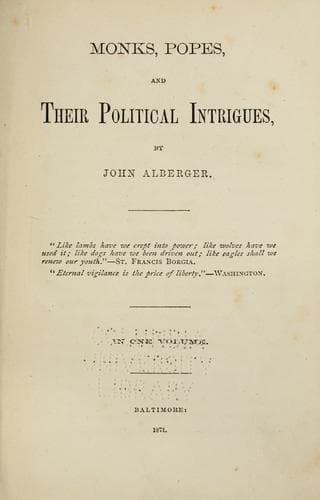
Monks, Popes, and their Political IntriguesAlberger, John
History
Monks, Popes, and their Political Intrigues
Alberger, John
Catholic Church; Catholic Church -- United States; Church and state
The alleged gift of Pepin to the Roman See forms another pretext by
which the popes have endeavored to lay a basis for their claim to the
right of temporal sovereignty. Pope Gregory excited a rebellion against
the authority of the Emperor Leo III., in the course of which the
Italian Exarcate was dismembered from the empire. It was decided by the
victors that the government should be administered by two Consuls, in
which the pope should participate, not in a secular, but in a paternal
capacity. For a monarch claiming the world as a just inheritance,
and all princes and governors as his menials, to accept such a humble
concession to his unlimited authority, and such an ambiguous office, is
the most remarkable instance on record of a monarchial condescension.
He, however, not only accepted it, but what is still more surprising,
accepted it with eagerness and gratitude; and even intrigued to obtain
it. But during the administration of Pope Stephen II. the victorious
sword of the Lombards wrung the Exarcate from the Consular government
of Rome. The pope, to retrieve his fortunes applied to Pepin, Mayor
of France, who, responding with an adequate force, reconquered the
Exereate, and expelled the barbarians. Grateful for the martial services
of Pepin, the pope solicited of the civil authority the privilege of
appointing him Patriarch of Rome, a title which was borne by the former
Exarchs; and by this innocent method initiated a precedent which soon
ripened into a prerogative of appointing civil magistrates. Having thus
advanced the interests of the Holy See by complimenting its deliverer,
he next ventured to anoint his head with oil, in hopes that in thus
imitating the example of Samuel in anointing kings, future popes might
have a pretext for usurping his prerogatives in acknowledging their
right to reign. Pepin, who ruled France under the title of Mayor, wished
to imprison the heir to the throne and usurp the government, and the
pope gave him his opinion that it was best for him to do so. In grateful
consideration of these extraordinary favors, it is alleged by the popes
that Pepin bestowed the conquered domains, consisting of the Exereate
and the Pentopolis (five cities) on the See of Rome, as supreme absolute
lord. It is, nevertheless, certain, that Pepin's donations to the Holy
See were on condition of its vassalage to the Frankish power, and that
during his life he exercised absolute sovereignty over Rome, and
over all his conquests, and allowed no pope to be either elected or
consecrated without his permission.
Public-domain text, read in full here on John Shaqi.
Reviews
Reviews
No reviews yet
Be the first to share your thoughts on this work.
Elsewhere in the archive
Join the Discussion
Join the discussion
Sign in to leave a comment or review.
Sign InorCreate an account