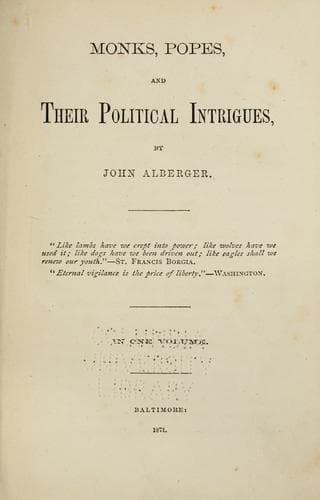
Monks, Popes, and their Political IntriguesAlberger, John
History
Monks, Popes, and their Political Intrigues
Alberger, John
Catholic Church; Catholic Church -- United States; Church and state
By a succession of forgeries, usurpations, and skilful manoeuvres the
papal government advanced, in the progress of events, from an obscure
origin to supreme secular and spiritual jurisdiction. By gradual steps
the popes acquired the right to decide on ecclesiastical and matrimonial
questions; to dispose of church dignities and benefices; to protect
their temporal acquisitions from alienation by the interdiction of the
marriage of the clergy; to abridge the investiture of bishoprics by the
princes; to reduce the clergy to absolute dependence on their favor by
dissolving all bonds of interest which subsisted between the bishops and
the princes; to convene at option synods and councils, and to exercise
the prerogative of ratifying their decrees; to command the concession of
their infallibility; to enforce confessors on princes and statesmen; to
introduce the inquisition into kingdoms; and to regulate and superintend
schools and colleges. The attainment of these objects was the work
of centuries. Conceiving a desire in one age, they plotted for its
accomplishment through the events and discords of succeeding ages; and
when machinations had matured their plan, they consummated their wishes
by usurpation. The pretensions to the alleged donation of Pepin, of
Charlemagne, of Matilda, and of the Gothic princes, were not asserted
until long after the death of the pretended donors, nor until art and
intrigue had prepared the way for it. The alleged grant of Constantine
was first announced in 765 by Pope Adrian I., in an epistle to
Charlemagne. The claim to the estates of Matilda was first made by Pope
Paschal, on the ground that they were granted to the Holy See as a fief;
and next by pope Innocent II., on the ground that they had been granted
to it as lord paramount. The participation of Pope Leo III. in the
Consular government of Rome, in a paternal capacity, was the first
instance of a pope's exercising temporal authority. The anointing of
Pepin by Pope Adrian I., in imitation of the example of Samuel, was the
first semblance of the pope's usurpation of the prerogatives of that
official in acknowledging the right of kings. The victory of Nicholas I,
over the Emperor Lothair, was the first papal triumph over the secular
authority. The coronation of Charles the Bold, in 875, by Pope John
VIII., was the first act of the papal monarch in disposing of crowns.
The conquests of Robert Guiscard, instigated by promises of the popes,
furnished the first ground of their feudal claims. The fear of the
terrible consequences of their anathemas and interdictions, the ill
regulated constitution of the European States, the imperfection of
domestic and international law, and the efficient operation of the papal
machinery, enabled them to render kingdom after kingdom tributary to the
Holy See. England, from the period of the introduction of the Catholic
church into her realm; Belgaria and Aragon, from the eleventh century;
Public-domain text, read in full here on John Shaqi.
Reviews
Reviews
No reviews yet
Be the first to share your thoughts on this work.
Elsewhere in the archive
Join the Discussion
Join the discussion
Sign in to leave a comment or review.
Sign InorCreate an account