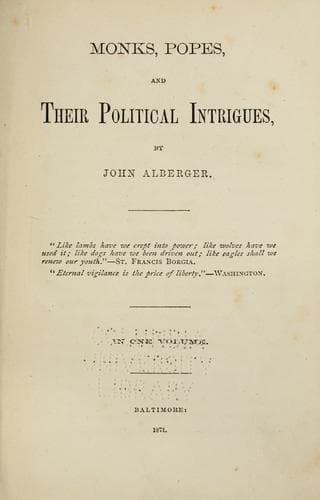
Monks, Popes, and their Political IntriguesAlberger, John
History
Monks, Popes, and their Political Intrigues
Alberger, John
Catholic Church; Catholic Church -- United States; Church and state
The papal monarchy is certainly one of the most crafty, demoralizing,
and oppressive despotisms that has ever disgraced the name of
government. Its ambition is insatiable, its duplicity inscrutible, and
its policy and measures are disgraceful and unprincipled. The popes
have converted the courteous indulgence of friendship into inviolable
rights, and from the feeblest concession have manufactured the most
exorbitant claim. Pretending to be spiritual advisers, they became
temporal despots. Soon as they had acquired the right of owning a farm,
they asserted the fight of owning a kingdom; and when the right was
conceded of owning a single kingdom, they claimed the right of owning
all the kingdoms of the earth. A church, a mission-house, an acre of
land they construed into an implication that they had a right to all
power, temporal or spiritual, for which their capacious maw could crave.
They first founded mission-houses in different parts of the world;
next they claimed absolute jurisdiction over them. Disputes respecting
property arising between the citizens of Rome and these foreign
mission-houses of the church, the popes claimed the exclusive right to
arbitrate between them. The right to arbitrate gave them the power to
judge, and the opportunity of adjusting disputes according to their
advantage. As ecclesiastical litigation conduced to the extension of
their authority, pontiffs were not always too honorable to discourage
the causes which favored their mediatorial interposition. From the right
to arbitrate between churches, they next claimed the right to arbitrate
between subjects, then between cities, then between nobles, and then
between monarchs. As their mediation in church or state affairs enabled
them to adjust disputes according to their policy, they insidiously
labored to multiply the causes which favored their friendly
intervention.
Public-domain text, read in full here on John Shaqi.
Reviews
Reviews
No reviews yet
Be the first to share your thoughts on this work.
Elsewhere in the archive
Join the Discussion
Join the discussion
Sign in to leave a comment or review.
Sign InorCreate an account