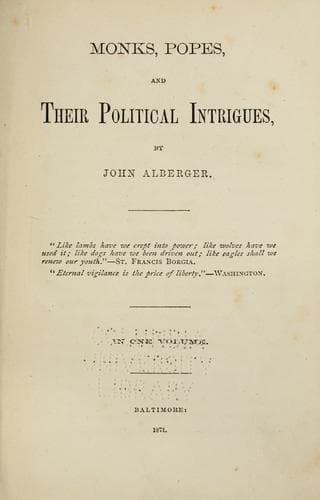
Monks, Popes, and their Political IntriguesAlberger, John
History
Monks, Popes, and their Political Intrigues
Alberger, John
Catholic Church; Catholic Church -- United States; Church and state
The Papal See governed by an unscrupulous ambition to realize
the success of its projects for acquiring unbounded territorial
aggrandizement, has, with equal craft and baseness, endeavored to make
the vices as well as the power of princes administer to its interests.
This policy is illustrated in the schemes of papal policy and intrigue
concocted under the reign of King John, youngest son of Henry II., who
on the decease of his father in 1199 ascended the English throne. This
prince had conspired against the most indulgent of fathers, had warred
against his brother Richard, had murdered his brother Arthur, had
repudiated his wives, and had exercised regal authority with insolence
and tyranny, without provoking the maledictions or interference of the
Holy See. But as these enormities deprived him of the affections of his
subjects, a ruler's chief support; exhausted his coffers, the sinews of
war and opposition; made him more dependent on the favor of Rome, more
entangled in the network of its policy, and admirably prepared the way
for the accomplishment of its ulterior designs, its indulgence, and
perhaps connivance may be reasonably accounted for. But after a war with
France exhausted the resources of John, rendered him less popular, and
more irascible and impatient, Pope Innocent III. improved the flattering
opportunity which crime and misfortune had presented, to provoke a
collision with him favorable to the success of the papal designs. John
claimed the right of investiture; and in making this claim seems to have
been supported by the cooperation of the papal political machinery.
The See of Canterbury having become vacant, the pope appointed Cardinal
Langston to fill the vacancy. This act John resisted as an unjustifiable
encroachment on the prerogatives of the crown. But the arts of the pope
had involved the king in a snare; and now having fairly entangled him,
proceeded to prepare the way for realizing his temporal project by
exercising his spiritual functions. Accordingly he suspended the
performance of religious worship in the king's dominions, excommunicated
him, and absolved his subjects from their allegiance to him. The papal
political machinery acting in harmony with the maledictions of the pope,
the wildest disorders were excited among the people; anarchy suspended
all law; the army refused to obey the king's orders; his friends
deserted him; and he found himself without domestics, without alliances,
and without the means of resistance. It is an invariable practice of
the holy fathers, who claim a right to all the world by virtue of
their office, to endeavor to supersede the necessity of this title
by acquiring a legal one. Hence, Innocent III., seeing the helpless
condition to which he had reduced John, and touched at the cruel
misfortunes in which he had involved him, now graciously proposed to
mitigate the rigors of his adversities, and to restore him to his former
Public-domain text, read in full here on John Shaqi.
Reviews
Reviews
No reviews yet
Be the first to share your thoughts on this work.
Elsewhere in the archive
Join the Discussion
Join the discussion
Sign in to leave a comment or review.
Sign InorCreate an account