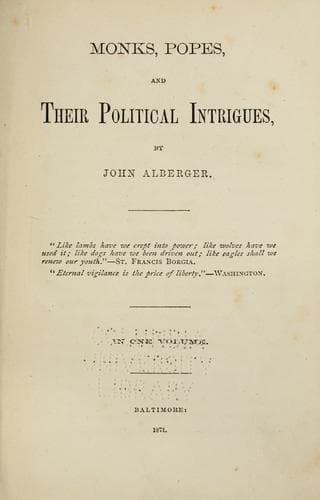
Monks, Popes, and their Political IntriguesAlberger, John
History
Monks, Popes, and their Political Intrigues
Alberger, John
Catholic Church; Catholic Church -- United States; Church and state
authority, if he would cede his kingdom to the Pope of Rome, and consent
to rule it as a vassal of the pope, Divested of adherents, arms or
alliances, the king submitted unconditionally to the terms dictated by
the sacerdotal despot. The design of the papal See of reducing England
to a state of vassalage, conceived in ambition, pursued by craft and
cruelty, was thus consummated by the most execrable tyranny. This
empty title to England and Ireland, so full of trick and fraud, is
nevertheless still mentioned by the Holy See as valid and indisputable.
But the benefits of the statesmanship, and of the divinely inspired
council of the holy father, by which John was bound in future to be
governed in the administration of his kingdom, did not prevent him from
exciting the indignation of his subjects, by encroachments on their
rights; nor restrain him from the perpetration of such unwarrantable
acts as created a popular hatred of him, which finally culminated in
open resistance to his authority. So violent were the conflicts that
arose between him and his subjects, that in order to save his crown he
had to yield to their demand the act of the "Magna Charta." The pope,
however, the natural foe of all constitutional guarantees of popular
right and liberty, benevolently interposed in behalf of the imbecile and
overawed prince, and absolved him from all obligations to comply with
any of the unpleasant concessions which he had made; declaring the Magna
Charta antagonistical to the Catholic religion; forbidding the king
to observe any of its provisions; and pronouncing sentence of
excommunication on all who should obey, or attempt to enforce the
heretical act. Again the papal machinery was set in violent operation.
Spies watched, confessors reported, abbots schemed, bishops predicted,
priests thundered, monks prowled and assassins murdered, until every
city, village and house, was distracted with alarm. In the midst of
the consternation which stupefied the public mind the king, through the
instrumentality of the papal machinery, suddenly appeared at the head
of a formidable army; and as if he were a foreign enemy, commenced
butchering his subjects, firing their dwellings and carrying terror and
devastation through his own kingdom. So profoundly secret were the
papal machinations carried on, and so suddenly and unexpectedly had John
appeared with an army fully equipped for war that--no suspicion of such
a design having been excited in the minds of the military barons--no
preparations were made to meet the emergency. As suddenly, mysteriously,
and adroitly as King John's army had sprung into existence, so did the
barons resolve, in order to defeat its object, to tender the crown of
the realm to France; which proffer being accepted, the intrigues of the
pope were thwarted, and Philip of France became sovereign of England.
Public-domain text, read in full here on John Shaqi.
Reviews
Reviews
No reviews yet
Be the first to share your thoughts on this work.
Elsewhere in the archive
Join the Discussion
Join the discussion
Sign in to leave a comment or review.
Sign InorCreate an account