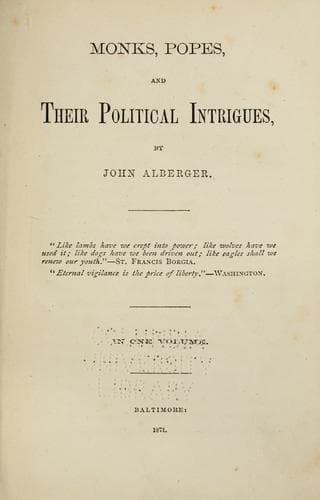
Monks, Popes, and their Political IntriguesAlberger, John
History
Monks, Popes, and their Political Intrigues
Alberger, John
Catholic Church; Catholic Church -- United States; Church and state
Happening to become enamored of Anne Bolyne, he began to suspect the
legality of his marriage with Catherine; and though he had recognized
its obligations by a union of twenty years, yet the oftener he saw
his mistress the stronger became his convictions of the heterodoxy and
unlawfulness of his matrimonial relations, and the more scrupulous he
became about his chastity. The want of male issue, and the disparity of
years between him and his wife mingled reflections with these legal and
religious scruples, and made them so pungent that Henry, in order to
get rid of the torment thus inflicted, finally applied to the pope for
a divorce. The pope promised to grant his request; but the fear of
offending Charles V., Catherine's nephew, produced strange vacillation
in the mind of the infallible holy father. Two powerful and crafty
princes dictated to him opposite courses; to offend either would be
disastrous; he therefore pretended to favor the wishes of both. Aware of
papal artifice, however, Henry became imperious in his demands. The pope
appeared to yield, and to soothe the impatient prince with a semblance
of compliance, but a means of procrastination, he commissioned Cardinals
Wolsey and Campaggio to adjust the difficulty. They cited the queen
to appear before them; she appealed to the pope; they declared her
contumacious. By these proceedings the controversy becoming more
embarrassed than before, and less capable of a speedy solution, Henry
peremptorily decided the matter by consummating his marriage with Anne
Bolyne. This act astonished the pope, and enraged Charles V. To gratify
Charles, and to punish Henry, the holy father proceeded to excommunicate
the latter. The despotic character of Henry, however, had too much
overawed his subjects to allow the papal machinery to give much efficacy
to the manifestos of its prime engineer; and placing himself at the
head of the Catholic church in England, he released his subjects from
allegiance to the See of Rome, effected a separation from it, and
nullified its temporal authority over his dominions.
Public-domain text, read in full here on John Shaqi.
Reviews
Reviews
No reviews yet
Be the first to share your thoughts on this work.
Elsewhere in the archive
Join the Discussion
Join the discussion
Sign in to leave a comment or review.
Sign InorCreate an account