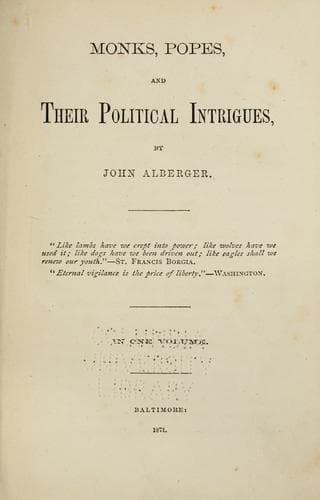
Monks, Popes, and their Political IntriguesAlberger, John
History
Monks, Popes, and their Political Intrigues
Alberger, John
Catholic Church; Catholic Church -- United States; Church and state
The popes claim the divine attribute of infallibility, yet in changing
their policy and practice to suit the variations of time, place and
circumstance, they seem generally to have descended to the common level
of humanity. In order, however, to reconcile the irreconcilable, while
they profess to have had communicated to them the incommunicable, they
claim to have been endowed with power to change the unchangeable. Should
a prince resolve to do that which the pope's infallible holiness
has declared to be criminal, and should that prince happen to be too
powerful to be intimidated, and too dangerous to be provoked into
rebellion, in such, delicate cases the pope, with his facilities
to accommodate all difficulties, grants a dispensation, whereby the
applicant is empowered to violate all the infallible laws of the church
without incurring any of their penalties.
In the reign of Henry VII., who became king of England in 1485, we find
an illustration of this policy. That sovereign had married Arthur, his
eldest son, to Catherine, daughter of Ferdinand, king of Arragon. On
the decease of Arthur, the king, with the view of retaining the opulent
Spanish dowery in his family, desired to marry the widow of Arthur to
his next son. The young prince Henry, but fifteen years old, protested
against marrying a lady for whom he had no affection, and who was so
much his senior. Besides this difficulty the contemplated alliance was
in violation of the laws of consanguinity, so solemnly established by
the authority of the infallible church, and so terrifically armed
with all the terrors of anathemas and excommunication. To silence the
objection of his son, and the thunders of the Vatican, Henry applied
to the pope for permission to execute his purposes, in violation of the
established laws of the church; and the pope, not deeming it prudent
to offend so powerful a potentate, granted his request But vain are the
pope's pretensions to be able to change the moral law of heaven unless:
he can also change the natural course of events. In this attempt to
accommodate principle to interest, and the infallible laws of the church
to the changing whim of an avaricious monarch, he laid the foundation
for the final separation of the kingdom of England from the See of Rome.
After the death of Henry VII. his son, under the title of Henry VIII.,
succeeded to the British throne. Frank and vain, he became at an early
period of his life an object of the subtle policy of Rome. Naturally
generous, his indomitable love of power and dominion often led him
to violate the obligations of humanity; and impetuous in passion, and
impatient of restraint, he was tempted to annihilate the constitutional
restraints which conflicted with his designs, and to make the forms of
justice subservient to the gratification of his ambition and interest.
Public-domain text, read in full here on John Shaqi.
Reviews
Reviews
No reviews yet
Be the first to share your thoughts on this work.
Elsewhere in the archive
Join the Discussion
Join the discussion
Sign in to leave a comment or review.
Sign InorCreate an account