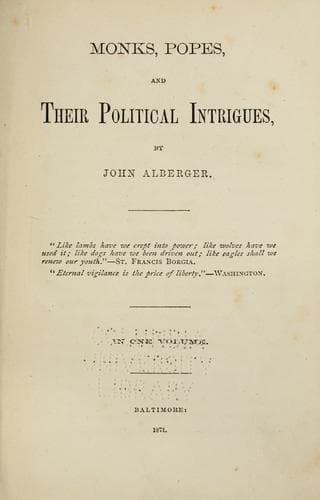
Monks, Popes, and their Political IntriguesAlberger, John
History
Monks, Popes, and their Political Intrigues
Alberger, John
Catholic Church; Catholic Church -- United States; Church and state
The inveterate opposition to Catholics in England rendered it almost
impossible for a Catholic to ascend the throne, and eventually
interdicted it by positive enactments. To counteract the consequences of
this spirit, a scheme was projected by papal craft to have the heirs of
the throne educated by Catholic mothers, so that future kings might
rule as Protestants with Catholic proclivities, and in course of time,
through the demoralization, dissatisfaction, discord and blood effected
by the cooperation of its adherents, the supremacy of the pope might
be reestablished in England, James I., who on the death of Elizabeth
succeeded to the crown of England and Scotland, a ruler devoid of
statesmen-like abilities, without firmness or stability, and bloated up
with fanciful notions of royal prerogatives, was the pliant instrument
of this subtle policy. An amorous flame having been kindled in him and
in Henrietta Maria, daughter of Henry IV., of France, it was stipulated
that the union should be consummated, on condition that the heirs which
should issue should be subject to the exclusive control of their mother
until they were thirteen years of age. This contract secured a Catholic
education to the heirs of the British throne, and laid the foundations
for the dreadful calamities which afflicted the nation during the reigns
of Charles II. and James II.
The abolition of papal despotism over the English mind giving freedom to
thought and inquiry, could not but enlarge its conceptions of civil and
religious liberty. The old system of prerogatives sunk into contempt,
and the new system of representative government became more popular as
the mind became more comprehensive in its grasp, and more profound in
its investigation. Hence the Puritans, who originally were Catholics,
and merely advocated a simpler form of worship; the Presbyterians and
the Independents, who at first questioned only the temporal power of the
pope, yet driven from those whom they had venerated by the hate which
persecution engenders, and disenthralled from the shackles with which
custom and superstition enslaves the mind, began fearlessly and candidly
to investigate the fundamental principles of faith and practice, and
to elaborate theological creeds totally different from those of
Catholicism, and vastly superior to them. While the people were rapidly
advancing in liberal views of religion and government, the heir of the
throne was too much absorbed in magnifying his visionary prerogatives
to share in the progress of the age, or to study the character of the
people over whom he was destined to reign. When in 1625 he ascended the
English throne, under the title of Charles I., the new order of popular
sentiment had become an impetuous torrent. Common sagacity might have
perceived the inevitable destruction that would await him if he should
attempt to stem the popular tide of thought; and prudence would have
dictated a practicable compromise of differences rather than the certain
Public-domain text, read in full here on John Shaqi.
Reviews
Reviews
No reviews yet
Be the first to share your thoughts on this work.
Elsewhere in the archive
Join the Discussion
Join the discussion
Sign in to leave a comment or review.
Sign InorCreate an account