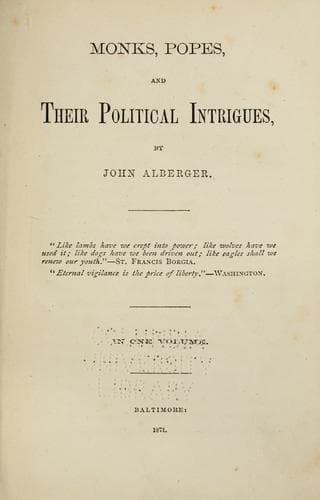
Monks, Popes, and their Political IntriguesAlberger, John
History
Monks, Popes, and their Political Intrigues
Alberger, John
Catholic Church; Catholic Church -- United States; Church and state
alternative of civil war. But Archbishop Laud, a Catholic under
the disguise of Protestantism, and who was the medium of the pope's
influence, exercised a despotism over the king's mind too absolute to
allow his reason to instruct, or his conscience to admonish him. The
religious views and secret designs of this professed Protestant bishop
cannot be misunderstood. He maintained that the papal authority
had always been visible in the realm. He furnished the king with
a significant list of the names of all his Catholic and Protestant
subjects. He was also the principal actor in the Star Chamber, and Court
of High Commission. So well was the pope satisfied with the orthodoxy
of this sacerdotal miscreant that he sent him a cardinal's hat, which he
declined for the ambiguous reason that the "Church of Rome was no other
than it was!" The king, controlled and ill-advised by such a counsellor,
blinded by his own bigotry, and elated with self-conceit, was led to
scorn the rising spirit of the nation, and to adopt measures for its
suppression. But parliament with prudent foresight, and patriotic
boldness, taught him that the Commons were the constitutional dispensers
and guardians of the public treasury. He next resolved to oblige
Scotland to conform to the ritual prescribed by the Church of England;
and as parliament had refused to allow him the use of the public funds
for that and other purposes, he attempted to raise means for their
accomplishment by unconstitutional methods. By this impolitic course he
aroused a lion from its den, with whose strength and fury he could not
well cope. The Scotch formed a league of Covenanters, composed of all
classes and factions, for the defence of their religious liberty; and as
the king viewed their enthusiastic and formidable array, and compared
it with the suspicious material of his own army, he prudently concluded
terms of pacification.
Public-domain text, read in full here on John Shaqi.
Reviews
Reviews
No reviews yet
Be the first to share your thoughts on this work.
Elsewhere in the archive
Join the Discussion
Join the discussion
Sign in to leave a comment or review.
Sign InorCreate an account