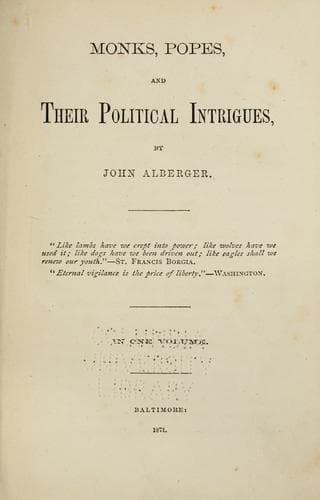
Monks, Popes, and their Political IntriguesAlberger, John
History
Monks, Popes, and their Political Intrigues
Alberger, John
Catholic Church; Catholic Church -- United States; Church and state
attempt to retrieve his fortune by asserting in his extremity his empty
prerogatives, he brought his precarious condition to an unfortunate
close. Entering the House of Commons, he personally attempted to arrest
some of its members. The House, consequently, broke up in disorder; the
king saw his error, but too late; he fled from his capitol in terror;
two armies arose; the one under the king, the other under parliament:
after several bloody battles, the king lost his crown, and finally his
life.
Parliament now resolved to rule without a king as the king had resolved
to rule without a parliament. The spirit of despotism under the form
of freedom, still, however, predominated in the national councils.
Cromwell, a professed republican, but a secret monarchist; as intolerant
as he was religious, and crafty as he was ambitious; who, as interest
instigated, favored or persecuted Catholics, Protestants, Puritans,
and Republicans, was this despotic spirit which desecrated the form of
Freedom, and which induced him while he governed England as a protector,
to seek to govern her as a king, and to plot in secret to reestablish
her throne. After the termination of his eventful career, and the
resignation of his appointed successor, Charles II., son of James I., in
1660 was crowned King of England.
Illiberal in mind, intolerant in disposition, defective in sensibility,
and destitute of honor and generosity, he was base as a man,
dishonorable as a prince, and a pliable instrument of the papal
intrigues. A hypocrite from his birth, he was capable of assuming any
guise; and supremely selfish, he tolerated vice and corruption whenever
it administered to his interests. By the licentiousness of his court
he degraded the moral standing of the British nation in the eyes of
the world and of history, and with a despotic and unprincipled set of
measures, arrogated power in defiance of constitutional obstructions,
and reduced the people to slavery in contempt of their hereditary valor
and independence, and the safeguards with which they had protected their
liberty.
The pathway to his elevation to the throne having been prepared by
General Monk, he was received with frantic acclamations by conflicting
civil and religious sects, and without a struggle succeeded to those
danger-our prerogatives which had cost the nation so much blood and
treasure. The admonition of past occurrences had induced him to disguise
under the cloak of a pacific and accommodating policy, his secret and
ulterior designs. But the specious mask fell from his brow when he
passed the intolerent act of non-conformity, by which the Presbyterians
were peremptorily driven from their livings.
Public-domain text, read in full here on John Shaqi.
Reviews
Reviews
No reviews yet
Be the first to share your thoughts on this work.
Elsewhere in the archive
Join the Discussion
Join the discussion
Sign in to leave a comment or review.
Sign InorCreate an account