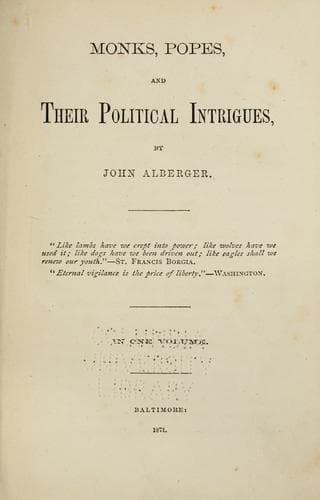
Monks, Popes, and their Political IntriguesAlberger, John
History
Monks, Popes, and their Political Intrigues
Alberger, John
Catholic Church; Catholic Church -- United States; Church and state
Having frequently called the Commons together in parliament, and finding
them more disposed to dictate than to obey, and inflexible in their
refusal to furnish him with the pecuniary aid necessary to the
accomplishment of his design, he finally determined to rule without
a parliament, and by a liberal construction of his prerogatives to
arrogate monarchial power. An object so consistent with the dogmas of
Catholicism, and so flattering to the vanity of the Episcopal royalists,
equally betrayed them into acquiescence. To aid the king in his despotic
design the royalists extolled his prerogatives, asserted their divine
origin, declared it impious to prescribe any limits to them, and
inculcated passive obedience as a Christian virtue and imperative duty.
The terror of the Star Chamber, and of the Court of High Commission,
was also called into requisition. But neither the eloquent encomiums
lavished on the king's prerogative, nor the atrocities of the Star
Chamber, nor the severity of the Court of High Commission, nor a
rebellion excited in Ireland against parliament, nor the arms of the
royal troops, produced anything for the king's prerogatives but disgrace
and ridicule. Dreading the liberalism and inflexibility of the Commons,
and the uncompromising hostility against his person and measures which
his persecution of non-conformists had excited in the majority of them,
yet he was obliged, by the critical state of public affairs, to call
them together. This parliament proved the memorable "long parliament."
As might have been expected, its embittered and exasperated members
opened the session with torrents of scorn and contempt poured on the
king and his prerogatives. They also adopted every expedient to inflame
the public mind, and to make it accessory to their design of reducing
the king to unresisting helplessness. They denounced the Episcopalians,
and other advocates of the king's prerogatives, in whom Catholicism and
monarchy had disguised themselves under the semblance of Protestantism.
They attempted to exclude the bishops from the House of Lords. They
so intimidated the royalists of the House that many of them absented
themselves from their seats. They restricted the king's prerogatives,
abolished the Star Chamber, and the Court of High Commission, passed
acts against superstitious practices, executed Laud and Stafford, and as
the king had set the dangerous precedent of liberal construction of law
and prerogatives, they availed themselves of the same means to justify
their measures. The impetuous tornado of their zeal and wrath swept
away all the king's elaborate schemes for the acquisition of monarchial
power, and poured upon his unprotected head a pitiless storm of wrath.
Condemned to be the helpless spectator of the destruction of his hopes
of absolute power, which art, tyranny, and usurpation had enabled him to
build, he became wild with despair and rage, and, in a desperate
Public-domain text, read in full here on John Shaqi.
Reviews
Reviews
No reviews yet
Be the first to share your thoughts on this work.
Elsewhere in the archive
Join the Discussion
Join the discussion
Sign in to leave a comment or review.
Sign InorCreate an account