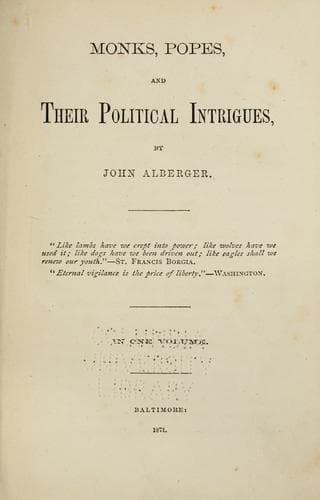
Monks, Popes, and their Political IntriguesAlberger, John
History
Monks, Popes, and their Political Intrigues
Alberger, John
Catholic Church; Catholic Church -- United States; Church and state
James II., brother of Charles II., in 1685 succeeded to the throne of
England and Scotland. Educated like his brother, he had imbibed similar
religious and political sentiments. While Duke of York he at first
secretly, but afterwards openly, professed the Catholic faith. When,
in the course of intrigue and conflict, the royal party had gained the
ascendency in Scotland, he retired thither; and manifested his barbarous
ferocity by personally assisting at the torturing of the Covenanters.
The rapid strides which his brother had made towards the acquisition of
absolute power, and the paralyzing dread which cruelty and tyranny had
cast over the public mind, enabled James II. to succeed to the British
throne without opposition. From the hour he became invested with the
royal dignity, he adopted every expedient that craft could devise to
convert his royal prerogatives into monarchial authority, and to secure
the restoration of Catholicism as the religion of the kingdom. As virtue
scorns to be the tool of vice, and as sycophants are the most pliable
instruments of despotism, he adopted the policy of investing the
most unscrupulous with official authority. Supreme among his base and
cringing creatures stood Judge Jeffrey. The chief engineer of the
papal machinery--the controlling spirit of the king and his councils;
insolent, imperious, arbitrary and oppressive, this man was ready for
any work that furnished sufficient blood and plunder. By barbarous and
inhuman acts, and by the arbitrary execution of innocent subjects, this
monster in human form succeeded in casting a deep gloom over the public
mind, and in annihilating all apparent opposition to the tyrannical
proceedure of the king. Amid the death-like silence which hung on
the lips of the people the king threw off his disguise, entered into
negotiation with the pope for the reception of England into the papal
church, celebrated mass invested with the royal paraphernalia, assumed
the power of parliament, nullified all test oaths, filled the councils
and army with Catholics, governed Scotland and Ireland by his creatures,
organized ecclesiastical tribunals to try such clergy as were suspected
of holding liberal sentiments, committed bishops to the Tower for having
remonstrated against the propriety of reading a document concerning a
popish indulgence which he had commanded to be read in all the churches,
and adopted every possible method to subvert civil and religious
liberty, and to bind on his subjects the shackles of papal despotism.
Towards the final consummation of his calamitous design he appeared to
be making rapid strides; but, though the papal machinery was formidable,
yet there was another power more formidable still; as wily and as
secret: which was quietly maturing its strength for the hour of
retribution. The oppressive measures of the king and the failure of
every attempt at compromise and conciliation, had created a stern
Public-domain text, read in full here on John Shaqi.
Reviews
Reviews
No reviews yet
Be the first to share your thoughts on this work.
Elsewhere in the archive
Join the Discussion
Join the discussion
Sign in to leave a comment or review.
Sign InorCreate an account