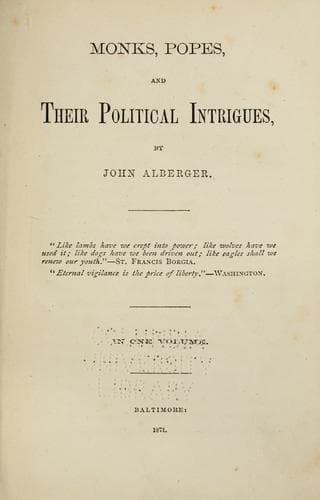
Monks, Popes, and their Political IntriguesAlberger, John
History
Monks, Popes, and their Political Intrigues
Alberger, John
Catholic Church; Catholic Church -- United States; Church and state
opposition in the mind of the people, of the gentry, and of some lords.
Silent but powerful, though this opposition seemed to slumber, yet
it was but calmly waiting the destined hour, when it would arise and
annihilate dynasties find prerogatives. While the king, deceived by the
treacherous calm, was trampling in insolent contempt on the people's
rights; while sycophantic priests were chaunting his song of triumph;
and while the pope was congratulating him on his success, and stretching
forth his hand to receive the kingdom, William of Orange suddenly
appeared on the coast of England with a formidable navy and army,
and, as with the stroke of an enchanter's wand, changed the calm and
brilliant prospects of the king into storms and sights of horror, and
the peans of his sycophants into howling and lamentations. Terrified at
the sight, the king repealed his unpopular acts, and proffered to
his subjects all the rights which they had in vain plead for before.
Conscious of their strength, and irreconcilable in the memory of their
wrongs, they rejected with scorn and indignation all his generous
overtures. As he had ruled as a tyrant, he now absconded as a coward.
The throne was declared abdicated, and William and Mary proclaimed
sovereigns of England and Scotland. After some fruitless attempts to
regain his kingdom, James II. turned Jesuist, and passed the remainder
of his life in doing penance, Edward, the Pretender, grandson of James
I., educated at Rome, was another instrument which the pope adopted to
establish his authority over the crown of England. This treasonable plot
was unanimously supported by the tory party. This faction had ever
been a prominent branch of the papal machinery. Under the disguise
of Protestantism, in 1680, the tories made vigorous efforts for the
subjugation of England to the papal dominion. They were the most
strenuous supporters of Charles II. In every scheme of oppression
and violence--in the persecution of dissenters, in the banishment of
patriots, in the murder of the advocates of popular freedom--in every
project of the king to grasp monarchial power, in the abrogation of
the free charters, in the assumption of despotic prerogatives, in
the efforts to abolish parliament, they were the bold and unequivocal
supporters. It was, therefore, consistent with their historic tradition
that they should welcome as allies of the pope the invasion of Edward,
and be ready to repeat their former atrocities in his cause. England's
vigilance, however, defeated Edward's first attempt, in 1742, but he
made another in 1745 which was more successful. Landing secretly in
Scotland with but seven trusty officers, yet such was the efficiency of
the papal machinery, that it soon enabled him to command an army which
made England tremble. But the contest was short and decisive. Although
he gained some important advantages, yet the signal victory over his
forces at Culloden, in 1746, effectually checked his career. Despairing
Public-domain text, read in full here on John Shaqi.
Monks, Popes, and their Political Intrigues — John Shaqi
Reviews
Reviews
No reviews yet
Be the first to share your thoughts on this work.
Elsewhere in the archive
Join the Discussion
Join the discussion
Sign in to leave a comment or review.
Sign InorCreate an account