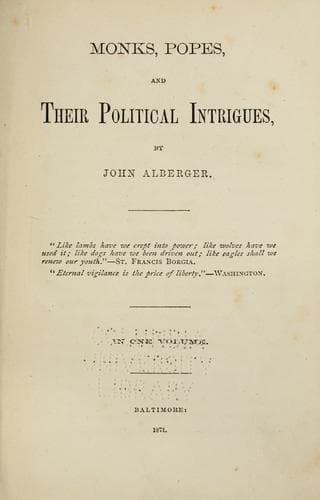
Monks, Popes, and their Political IntriguesAlberger, John
History
Monks, Popes, and their Political Intrigues
Alberger, John
Catholic Church; Catholic Church -- United States; Church and state
During the reign of Philip II., who became king of France in 1180,
the province of Languedoc enjoyed an eminent degree of liberty and
prosperity. The charters which the subjects had obtained from their
princes secured them in the enjoyment of many important civil rights,
fortified by such jealous guards as effectually protected them against
the encroachments of executive power. This liberality in their
political constitution encouraged liberality in religious inquiry, which
consequently led to doubts of the pope's right to temporal power. At
the flourishing city of Albi these progressive ideas assumed a definite
shape in an organization of the people, which received the appellation
of the Albigenses. The pope finding this sectary increasing in numbers
and popularity, in spite of the vigorous counteracting efforts of his
appliances of bishops, priests and monks, ordered Raymond VI., Count of
Toulouse, to compel the Albigenses, by force of arms, to change their
religious views. As Raymond of Rogers, Count of Beziers, nephew of
Raymond VI., had declared in favor of the reformer, the Count of
Toulouse refuse to oblige the pope by taking up arms against the Count
of Beziers. On account of this determination, dictated by a high and
delicate sense of duty and honor, the pope pronounced sentence of
excommunication against him. In addition to this insulting manifesto, he
commissioned his legate to raise an army of the cross, for the purpose
of exterminating the reformers and their allies. This authorized
desperado, through the energetic co-operation of the pope's political
machinery, soon collected a numerous army of crusaders; and imposing on
them a horrible oath that they would exterminate the Albigenses without
pity for the cries or tears of their wives or children, immediately
commenced the work of blood and devastation. As this army of murderers
approached the city of Carcassonne, an order was given not to leave
one stone upon another, and to put to death every man, woman, youth and
infant. The butchery was frightful, and mixed with the most fiendish
acts. To arrest the horrible work Raymond of Rogers offered to resign
his authority. With execrable treachery the legate pretended to be
willing to negotiate; but no sooner had he betrayed the Count into
his power than he incarcerated him in a dungeon, where he died after
experiencing years of suffering. After the removal of Raymond by this
base treachery, Carcasonne fell; and thirty thousand men, women and
children were butchered in one day. Tired of the terrible carnage, or
disgusted at its atrociousness, the chiefs of the army of the cross
declared to the legate, that among the crowd they could not distinguish
the heretic from the Catholic. "Kill on," replied the holy legate,
"God will know those which are his." The murderous army moved on; blood
flowed at every step; at Beziers sixty thousand were put to death; nor
did the carnage cease until the inhabitants of almost every town in
Public-domain text, read in full here on John Shaqi.
Reviews
Reviews
No reviews yet
Be the first to share your thoughts on this work.
Elsewhere in the archive
Join the Discussion
Join the discussion
Sign in to leave a comment or review.
Sign InorCreate an account