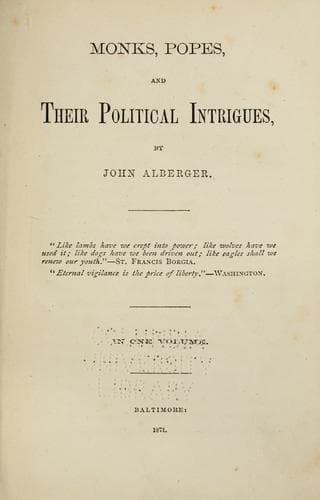
Monks, Popes, and their Political IntriguesAlberger, John
History
Monks, Popes, and their Political Intrigues
Alberger, John
Catholic Church; Catholic Church -- United States; Church and state
Pisa, for reformation in the head and body of the church; at the bar of
which they summoned the pope, to explain his conduct.
But scorning the mandate of the synod, he convened a council at the
Lateran; and causing a decree to be passed declaring Louis to have
forfeited his crown, excommunicated him, and interdicted the celebration
of religious worship in his kingdom. Louis was now assaulted by the
English at Guingate, by the Spanish at Navarre, by the Swiss at Dijon,
while his kingdom was internally convulsed by treacherous priests,
crafty spies, false friends, and unpatriotic Catholics. Unable to
contend against these formidable antagonists, he had to surrendered all
his possessions beyond the Alps and the Pyrenees.
Pope Leo X., who succeeded Julius II., governed by motives of nepotism
and ambition, concocted a scheme for obtaining for his family the
kingdom of Naples and the duchies of Ferrara and Urbino. At the
same time Louis entertained a design of reconquering Milan, which he
inherited from his grandmother, Valentina Visconti. The success of these
schemes depended on the mutual friendship of the projectors. The pope,
in order to secure the confidence of Louis, entered into a secret
alliance with him, and pretended to favor all his plans. But while he
was flattering his hopes, he was preparing to ruin his cause. To weaken
his resources he secretly sent Bambo, his legate, to Venice to detach
its alliance from France; and though this treacherous mission was
unsuccessful, yet when the French appeared on the confines of Italy, he
increased his power by the purchase of Modena, and finally reduced Louis
to a formal submission.
In 1515 Francis I, ascended the throne, and immediately commenced
preparations for the re-conquest of Milan. Pope Leo X., to defeat this
enterprise formed an alliance with Milan, Florence, Artois, Germany and
Switzerland. A bloody battle ensued in which tigers and giants seemed to
struggle with each other, and which was protracted without intermission
for two days and nights. France recovered Milan; the pope was reduced
to the last extremity; yet the prudence or superstition of Francis
concluded a concordat with him, upon such liberal terms as excited the
dissatisfaction of France, and the surprise of the world.
After this signal and generous triumph the belligerent powers became
reconciled. This event was hailed by the friends of humanity with united
acclamations. But the Holy See, whose policy has ever been to foster
wars and controversies between governments, that it might improve the
consequent confusion and disorder in aggrandizing its power, received
the news of pacification with chagrin and disappointment.
Public-domain text, read in full here on John Shaqi.
Reviews
Reviews
No reviews yet
Be the first to share your thoughts on this work.
Elsewhere in the archive
Join the Discussion
Join the discussion
Sign in to leave a comment or review.
Sign InorCreate an account