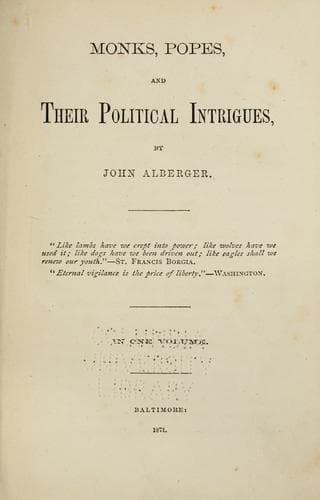
Monks, Popes, and their Political IntriguesAlberger, John
History
Monks, Popes, and their Political Intrigues
Alberger, John
Catholic Church; Catholic Church -- United States; Church and state
released; but as his character was black with crime, it was determined
to summon a council for his deposition. Depressed with the expectation
of certain degradation, chagrined and mortified at the loss of his
dignity and the insults to his holiness, and having refused all
sustenance in confinement for fear of being poisoned, his constitution
broke down, and he died in a paroxysm of rage and fear before
arrangements could be completed for his trial. According to Catholic
authority, "he entered like a fox, reigned like a tiger, and died like
a dog." His condition after his death may be variously conjectured by
theologians according to their different creeds; but Dante, who was a
Catholic, places him in hell between Pope Nicholas III. and Pope Clement
V.
During the reign of Louis XII., who became King of France in 1498, the
duplicity and treachery which has in general characterized the history
of the papal intrigues obtained an illustration in the conduct of the
popes, which would have disgraced the chiefs of barbaric nations. Louis,
upon receiving the royal diadem, pardoned the wrongs which had been
done to him while he was duke, relieved the industry of his subjects by
reducing the burden of their taxation, elevated the literary standard of
the nation by the introduction of scientific collections, and displayed
a nobleness of disposition, and a capacity for the exercise of the
governmental functions prophetic of the highest degree of national
prosperity and greatness. Pope Julius II. before his election, had
professed the warmest friendship for Louis, and secured his influence
in gaining the sacerdotal crown. Having succeeded in this strategic
measure, his ambition led him to grasp at another object which he
conceived Louis's friendship might be made accessory in realizing. That
object was the obliteration of the Venitian republic. He accordingly
formed a holy league, called the "League of Cambray," with France,
Spain and Germany, for the accomplishment of his object. Faithful to
his obligations, Louis fought with distinguished bravery in the pope's
cause. His heroism won encomiums from all but from the holy father,
who was too jealous not to hate superiority, too selfish for sincere
friendship, and too sagacious not to perceive that in the further
developments of his aggressive designs he was bound to encounter in the
heroism and honor of Louis a powerful antagonist. The formidable valor
of the Venitian republicans in the defence of their government, the
mutual distrust among the allies, which they managed to excite, and
the conflicting interpretations of the terms of the compact eventually
dissolved the holy league. But the finesse of the pope, and the
adroitness with which he engineered his machinery, gave him the ability
to conciliate his difficulties with the republicans, and of inducing
that republic to unite with him in a league with Spain, England and
Switzerland, against France. Germany and France then called a council at
Public-domain text, read in full here on John Shaqi.
Reviews
Reviews
No reviews yet
Be the first to share your thoughts on this work.
Elsewhere in the archive
Join the Discussion
Join the discussion
Sign in to leave a comment or review.
Sign InorCreate an account