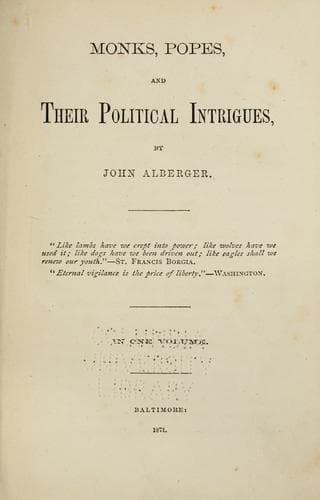
Monks, Popes, and their Political IntriguesAlberger, John
History
Monks, Popes, and their Political Intrigues
Alberger, John
Catholic Church; Catholic Church -- United States; Church and state
In 1559 Francis II., son of Francis I., succeeded to the crown of
France. Amid the flattering successes of the papal intrigues, the rapid
progress of Protestantism in Europe, and the fearless boldness of its
advocates, occasioned great uneasiness to the Holy See. Scorning the
mild but able services of reason and conciliation, it counselled the
most sanguinary measures. The records of the times are consequently
filled with accounts of disorders, assassinations, massacres, and the
most deplorable conflicts. The French nation was divided into two
great factions; the one in favor of Catholicism, the other in favor
of Protestantism. By means of the papal machinery of bishops, abbots,
priests, monks and spies, the Catholics were made to believe that the
religious disorders which had convulsed the empire were but a prelude to
an intended extermination of all Romanists. To narrow-minded bigots, who
absurdly believed that their church afforded the only possible method of
escaping the pangs of purgatory, and of obtaining eternal happiness,
all the zeal which their hopes and fears of eternity could inspire was
awakened in the defence of their religion. While the Protestants who,
on the other hand, believed that Catholicism was idolatry, subversive
of Christianity, demoralizing in its tendency, and destructive of the
rights of conscience, reason and religious liberty, became equally
heated in the defence of their faith. Both factions had been educated in
intolerent principles; in the belief that error of opinion was perilous
to the soul; that it rendered a person a proper object of aversion
and denunciation; and, that a difference of opinion was a sufficient
justification of hatred and persecution. Both factions being educated in
the principles of bigotry and intolerance, nursed amid convulsions and
barbarity, embittered against each other by mutual provocations
and injury, were incapable of pacification by just and reasonable
concession. The Catholics, having the power, were enabled to inflict
on the Protestants the deeper injuries; and, to the credit of the
Protestants it will ever be remembered, that they sought not to
exterminate their foes, but to obtain equal rights with them.
Public-domain text, read in full here on John Shaqi.
Reviews
Reviews
No reviews yet
Be the first to share your thoughts on this work.
Elsewhere in the archive
Join the Discussion
Join the discussion
Sign in to leave a comment or review.
Sign InorCreate an account