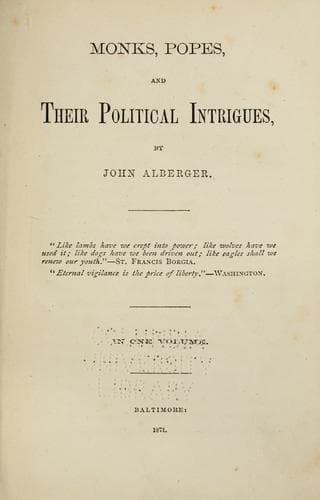
Monks, Popes, and their Political IntriguesAlberger, John
History
Monks, Popes, and their Political Intrigues
Alberger, John
Catholic Church; Catholic Church -- United States; Church and state
The Cardinal of Lorraine, who had supervision of the clergy, and Henry,
Duke of Guise, the uncle of the king, who directed the military affairs,
were both uncompromising in their hostility to the Protestants. Antony
of Bourbon, King of Navarre, and his brother Louis, Prince of Condé,
being excluded from the governmental administration, united with the
Calvinists for the overthrow of the regime, under pretext of religious
zeal. Catherine de Medici, mother of the king, and niece of Pope Clement
VII., jealous of a power in which she could not participate, favored the
designs of Louis, and employed her art in stimulating the opposition of
the reformers to the administration of the Duke of Guise. Under these
circumstances a conspiracy against the duke was formed at Amboise,
which led to a murderous onslaught, and inaugurated civil war. Louis was
captured and condemned to death.
In the midst of the distraction of conflicting parties Francis I. died,
and Charles IX., in 1560, succeeded to the throne at the age of
ten years. Catherine de Medici, his mother, with the acquiesence of
parliament, administered the affairs of government. Although a bigoted
Catholic, yet having no principle but the love of sway, she was ready to
support any faction or creed that administered to her power, or removed
an obstacle to her ambition. Without profound views of policy, she
was incapable of either originating a great national object, or of
supporting it by adequate measures. So indomitable was her passion
for dominion, that it as much obdurated her maternal feelings as
it disqualified her for a judicious regent. She even studied to
incapacitate her sons for the exercise of the governmental functions,
and to divert their attention from the state of national affairs. With
this end in view she involved them in the grossest dissipation, and
strove to keep them in a perpetual whirl of voluptuous intoxication.
Perfect in the art of dissimulation, she cajoled Catholics and
Protestants. Anxious to obtain the support of all parties, she
alternately favored the one and the other. To embarrass the Duke
of Guise she threw everything into confusion; but to conciliate
the Protestants she had to redeem her pledges; and in spite of the
opposition of the court, to issue an act of toleration in their favor.
Public-domain text, read in full here on John Shaqi.
Reviews
Reviews
No reviews yet
Be the first to share your thoughts on this work.
Elsewhere in the archive
Join the Discussion
Join the discussion
Sign in to leave a comment or review.
Sign InorCreate an account