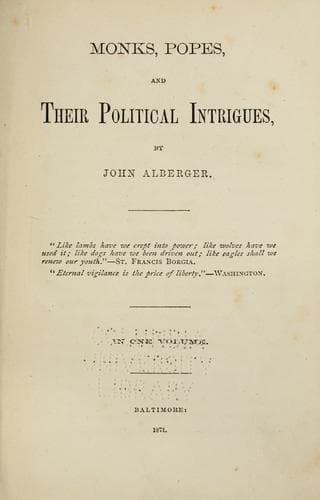
Monks, Popes, and their Political IntriguesAlberger, John
History
Monks, Popes, and their Political Intrigues
Alberger, John
Catholic Church; Catholic Church -- United States; Church and state
The arts of Catherine, the intolerance of Catholicism, and the suspicion
and fervor of Protestantism, soon convulsed the nation again with the
disorders of civil war. Aspiring to rule with more absolute power than
she had hitherto been able, Catherine conceived the idea of having the
king, whom she held helplessly under her control, declared to be
of competent age for the exercise of the royal functions. This
accomplished, she made a tour through the empire in company with him. At
Bayonne the young king had an interview with his sister, wife of Philip
II., King of Spain. The suspicions of the Calvinists were immediately
excited; they precipitately armed themselves for defence, and formed a
conspiracy to assassinate the king. Civil war consequently broke out. A
severe and bloody engagement took place at St. Dennis. The losses were
heavy on both sides; but Montmorency, a prominent Catholic leader being
killed, another treaty of peace was concluded. But the artifice and
dissimulation of Catherine only made treaties which contained the
elements of future wars. They satisfied neither the Catholics nor the
Protestants; and were evaded by both. Contrary to the stipulations of
the treaty of St. Dennis, the Calvinists still continued to hold places
which they had contracted to surrender, and to continue correspondence
with England and Holland, which they had agreed to break off. The
inflammable material of religious bigotry, together with these
circumstances, provoked another intestine war. The Duke of Anjou,
afterwards Henry III., commanded the Catholic faction; and Condé and
Admiral Coligny headed the Protestant faction. At the battle of Jarnac,
Condé was captured and shot; and at the battle of Montcontour Coligny
was defeated. Amid these discomfitures of the Protestants a peace was
offered them on terms of such extraordinary generosity by the Catholics,
that they were unconditionally accepted.
Public-domain text, read in full here on John Shaqi.
Reviews
Reviews
No reviews yet
Be the first to share your thoughts on this work.
Elsewhere in the archive
Join the Discussion
Join the discussion
Sign in to leave a comment or review.
Sign InorCreate an account