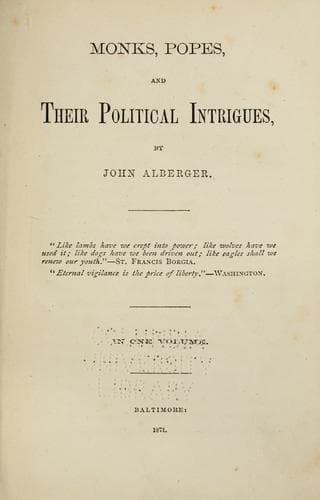
Monks, Popes, and their Political IntriguesAlberger, John
History
Monks, Popes, and their Political Intrigues
Alberger, John
Catholic Church; Catholic Church -- United States; Church and state
Henry of Navarre, Condé's son, subsequently Henry IV., on hearing of his
father's death swore to revenge his murder; but the peace which had just
been concluded rendered him destitute of means and arms. His mother,
Queen Jeanne d'Albret, after the death of her husband, Condé, King of
Navarre, had, in order to avoid the intrigues of Catherine, retired from
the French court to Bearn, her hereditary possessions. In this retreat
she declared herself in favor of the Huguenots. When her son was but
eleven years old the Guises, in conjunction with Philip II., King of
Spain, devised a plot for depriving the young prince of his hereditary
possessions in lower Navarre, and of placing him in the hands of the
latter tyrant. The sagacity of Elizabeth, Queen of England, however,
detected this conspiracy in time to frustrate it. In consequence of this
base machination, Queen Jeanne d'Albert placed her son Henry, when he
was but sixteen years old, at the head of a Protestant army, and caused
him to take an oath to shed the last drop of his blood in the defence of
his kingdom and religion.
Henry Guise, son of Francis Guise, Duke of Lorraine, became the
commander of the royal army. The bloody Catherine, in collusion
with this ambitious and bigoted duke, concocted a plot for the total
extermination of all the Protestants in the French empire. The peace
which had been concluded with the Protestants at Jarnac and Montcontour
was but the preliminary measure in the accomplishment of this horrible
project. The terms it accorded were so surprisingly advantageous to the
conquered forces, that the more cautious Protestants regarded it with
suspicion. The next device in this insidious plot, was a specious
pretence of uniting all parties in interest and harmony by the bonds
of two marriages, the one between the king, Charles IX., and Elizabeth,
daughter of Maximilian II., Emperor of Germany, and the other between
Margaret, the queen's sister, and Henry, Prince of Navarre. All the
distinguished Protestant leaders were earnestly invited to be present at
the celebration of the royal nuptials. Fearing treachery many of them,
however, declined the honor. Amid the magnificence and festivity of the
occasion Queen Jeanne d'Albert was poisoned. Shortly after Coligny was
wounded by a shot from a window. The king swore to punish the villain
who had attempted the assassination. His mother assured him Coligny had
the same designs on his life. Bursting into rage he exclaimed: "Kill
every Protestant--kill Coligny." Catherine then held her council
of blood. All having been concerted for a general massacre, on
Bartholomew's eve, at midnight of the day fixed, the church bells
announced the signal for commencing the horrible butchery. Wild shrieks
and murderous clamor immediately shook the air. "Spare none; it is
God's, it is Catherine's it is the kings order." shouted the Catholic
leaders as they led on their gangs of remorseless bigots. In the red
Public-domain text, read in full here on John Shaqi.
Reviews
Reviews
No reviews yet
Be the first to share your thoughts on this work.
Elsewhere in the archive
Join the Discussion
Join the discussion
Sign in to leave a comment or review.
Sign InorCreate an account