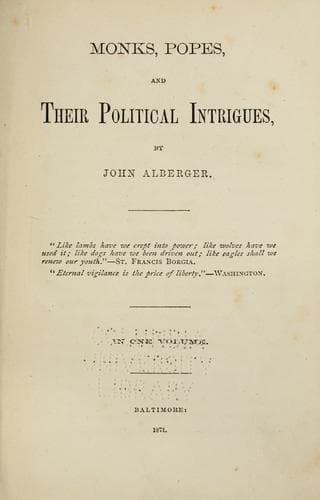
Monks, Popes, and their Political IntriguesAlberger, John
History
Monks, Popes, and their Political Intrigues
Alberger, John
Catholic Church; Catholic Church -- United States; Church and state
By the support of the papal machinery, Henry Guise became sufficiently
powerful to dictate laws to the king. He obliged him to annul all
provisions in favor of the reformers, and carried his insolence so far
that the king forbid him to approach the capitol. It was now discovered
that the duke intended to kidnap the king, imprison him in a monastic
dungeon, and usurp the imperial authority. Conscious of his power, the
duke boldly violated the king's command, that he should not enter Paris.
At this defiance the king called on his troops for assistance; but so
effectively had the pope's machinery operated, that the people attacked
the royal troops, drove them away, and thirty thousand papists sprung to
arms in the defence of the duke. Such was the helplessness of the king
that he had to fly for safety to Chartres, and to conclude a treaty with
his enemy. Upon the assembling of the Estates of Blois, they decided
that the duke was too powerful to be brought to trial, but that his open
treason would justify the king in having him assassinated. Appearing to
be reconciled to him he then partook of the eucharist in company with
him; but while he did so, gave secret orders for his assassination. In
a few days after this event the duke was stabbed as he entered the royal
palace, and Cardinal Lorraine met the same fate in a dungeon. The severe
disappointments which these melancholy events occasioned to the hopes
of the Papal See, gave rise to a holy league against Henry III., headed
by the Duke of Mayenne, brother of the Duke of Guise, which league was
supported by all the resources of Rome. Every department of the papal
machinery was now set in the most vigorous action. Paris and the
principal cities of France were incited to declare against the king. The
Sorbonne, the highest Catholic university in the empire, absolved the
subjects from their allegiance to him; the pope threatened him with
excommunication; and his assassination was publicly preached in the
churches; But by a fortunate coalition with Henry of Navarre the king
defeated the pope and his league, re-captured Paris, and established
again his authority in the empire. Yet the Catholic church, which never
forgives an offence, and scruples at no means to remove an obstacle,
found a Dominican monk who executed her vengeance by the assassination
of the king.
Public-domain text, read in full here on John Shaqi.
Reviews
Reviews
No reviews yet
Be the first to share your thoughts on this work.
Elsewhere in the archive
Join the Discussion
Join the discussion
Sign in to leave a comment or review.
Sign InorCreate an account