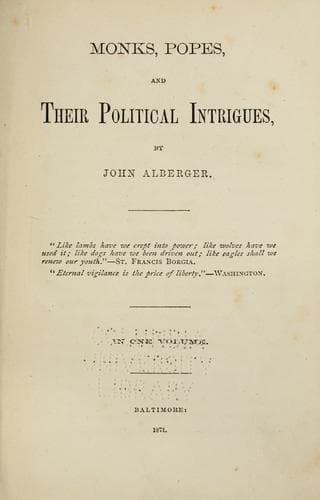
Monks, Popes, and their Political IntriguesAlberger, John
History
Monks, Popes, and their Political Intrigues
Alberger, John
Catholic Church; Catholic Church -- United States; Church and state
Henry III. left no male heirs; consequently Henry of Navarre became the
legitimate inheritor of the throne of France. The papal machinery which
in vain had been called into requisition to destroy him, was now set in
vigorous operation to prevent him from establishing a legal right to his
heritage. The Duke of Mayenne, at the head of the Catholics, declared
against him; Philip II., king of Spain, claimed the crown; and several
unsuccessful attempts were made to assassinate him. But the valor
and sagacity of Henry defeated his enemies, and triumphed over all
difficulties. The papal machinery was, however, still formidable; and
Henry IV., convinced that the blood of his subjects must continue to
flow as long as they were governed by a Protestant sovereign, decided to
profess the Catholic faith, which of all others he must have sincerely
detested. By this politic act of humiliation he acquired for his
subjects political security and entire religious liberty, and obtained
from the pope a concession to his right to the crown. But in sacrificing
principle to expediency he did not conciliate papal malice, nor secure
tranquillity to his reign. Conspiracies were rife, female intrigue
abounded, bigotry and intolerance gave birth to much violence and
disorder, and finally; the long-premeditated assassination of Henry
IV. was accomplished by Ravaillac, who stabbed him to the heart with a
double-edged sword, the papal symbol of spiritual and temporal power.
The papal machinery during the past reigns had demoralized the nation.
The national policy was characterized by a system of falsehood,
corruption and intrigue. Princes of the blood were excluded from the
throne, on account of their liberal proclivities. Innocent men, women
and children were imprisoned, murdered and burnt. Female intrigue, the
bane of national peace and virtue predominated in political circles;
and public robbery and extravagance laid the foundation of a debt which
ultimately broke down the government.
Under Louis XIII., who became King of France in 1610, the papal
machinery was directed by Cardinal Richelieu, who governed the king;
by M. Tellier, his confessor, and Madame Maitenon, his prostitute, who
governed the cabinet. Richelieu gave boldness and craft to the national
policy, and consummated the governmental absoluteness which had been
initiated by Louis XI. Division of power being more friendly to justice
and republicanism than consolidation, the papal political machinery has
always vigorously, as well as universally, labored to defeat the first
and encourage the second. But what is unfriendly to republicanism is
destructive to national prosperity; and consequently the papal intrigues
and appliances in favor of absoluteness in France destroyed the
greatness of the nation.
Public-domain text, read in full here on John Shaqi.
Reviews
Reviews
No reviews yet
Be the first to share your thoughts on this work.
Elsewhere in the archive
Join the Discussion
Join the discussion
Sign in to leave a comment or review.
Sign InorCreate an account