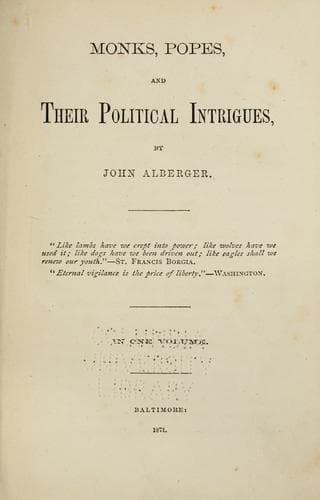
Monks, Popes, and their Political IntriguesAlberger, John
History
Monks, Popes, and their Political Intrigues
Alberger, John
Catholic Church; Catholic Church -- United States; Church and state
the affections and support of his subjects, he commanded the unpopular
monarch to appear before him, under pain of excommunication. In
punishment for this ferocious warrant the emperor summoned a council
of bishops at Worms, and obliged them to renounce their allegiance to
Gregory. This daring act so irritated the pope that he began to lavish,
with unsparing liberality, anathemas on the head of the monarch. Henry
at first treated this display of arrogated divinity with scornful
indifference, but his vices had too much disembarrassed the action of
the papal machinery not to allow it to disable his power and revenge.
His subjects disowned their allegiance to him; his friends deserted him;
his soldiers disobeyed his orders; and he found himself helplessly at
the mercy of a revengeful and irritated priest. With a refinement of
malice that seems to do credit to papal ingenuity, at least, the emperor
was required to dress in penitential robes, formally to solicit for
three days an interview with the sacerdotal despot, and then to promise
unconditional obedience to him in all things. But the acts of tyranny
carry with them the seeds of retribution. The tyrant who could impose
such conditions on a fallen foe, could also have been guilty, in the
exercise of his power, of inflicting injuries on his subjects which
would be calculated to excite a disposition to revolt and retaliation,
This was precisely the case with Pope Gregory VII. He had oppressed the
Italian provinces to such a degree that the inhabitants longed for an
opportunity to depose him; and now the misfortunes of Henry appearing
to render him an available agent in the accomplishment of their designs,
they proposed a coalition with him. The pope becoming acquainted with
this secret machination, set about to counteract it. By the operation of
his skilful machinery he was enabled suddenly to create a conspiracy
in the heart of Germany, for the deposition of the emperor; but the
vigilance and valor of the latter defeated the revolutionary movement.
Having in vain exhausted all resources to subject the incorrigible
monarch to his absolute authority, he now sought to beguile the
mortification of his defeat by hurling anathemas at his obstinate head.
But the temper of Henry not disposing him to indulge the chagrined pope
in insolent sports, summoned a council of German and Italian bishops at
Brixen, and by proving to their satisfaction that Pope Gregory VII. was
a heretic, a sorcerer, and had dealings with the devil, effected his
degradation, and placed Clement III. in the papal chair.
Public-domain text, read in full here on John Shaqi.
Reviews
Reviews
No reviews yet
Be the first to share your thoughts on this work.
Elsewhere in the archive
Join the Discussion
Join the discussion
Sign in to leave a comment or review.
Sign InorCreate an account