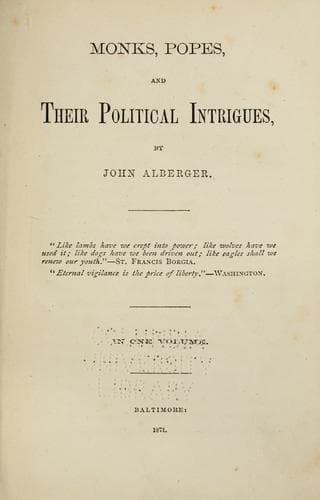
Monks, Popes, and their Political IntriguesAlberger, John
History
Monks, Popes, and their Political Intrigues
Alberger, John
Catholic Church; Catholic Church -- United States; Church and state
In the papal monarchy virtue and ability were seldom conspicuous, and
generally when either appeared in its administration, it was less the
offspring of Catholicism than of the Germanic authority. The emperors
of Germany were far better men than the popes of Rome. While the first
labored to reform the church, the latter did little else than corrupt
it. Virtue, the foundation of public order and concord, could not but
be encouraged in the subjects by a sagacious monarch; and vice, the
indulgent mother of fraud and imposition, could not but be cultivated
by a crafty and ambitious priest. In the progress of the conduct of the
papal and the imperial policy, so mutually antagonistical, Henry III.,
who became Emperor of Germany in 1046, had to depose three popes, and to
fill the papal chair during his life with men of his own choice. He
also held the papal monarchy under strict surveillance, and forbade the
bestowal of any spiritual dignity, or the appropriation of any church
property without his sanction. The wholesome effects of his severity
won commendations even from those upon whom they were most rigorously
enforced; in proof of which it may be stated that the clergy
spontaneously bestowed on him the title of "The Pious," which he
condescended to accept.
In 1056 Henry IV. ascended the throne of Germany. The Papal See,
bitterly groaning under the jealous restraint which had been imposed on
it by the secular authority, eagerly watched, and artfully intrigued for
an opportunity to remove them. The impolitic and tyrannical conduct of
Henry IV. appeared, perhaps in its eye, as a providential circumstance
designed to aid the success of its long cherished design. The emperor,
governed by the advice of Archbishop Adelbert, attempted, by building
castles, and committing brutal and violent acts, to rule his people
through the terror of his authority. Neglecting to guard popular
interests, which alone can secure popular attachment, his efforts to
overawe his subjects produced only dissatisfaction and insurrection. In
an outburst of popular violence provoked by his imprudence, considerable
damage was done to some churches in Saxony and Thuringia. These
disorders gave Henry the opportunity of gratifying his revengeful
feelings in accusing the inhabitants before the pope of sacrilege, and
of entering their territory and perpetrating the most barbarous cruelty.
The consequences of this proceeding eventuated in such a favorable
crisis to the papal designs, that, had the ablest pope projected and
engineered them they could not have culminated more propitiously. The
injured and exasperated inhabitants appealed to the pope. Pope Gregory
VII., having ascended the papal throne without the consent of the German
court, eagerly embraced a cause which enabled him to assert his claim
claim to independent sovereignty, and supremacy over all secular
authority. Fully aware that the tyranny of Henry had deprived him of
Public-domain text, read in full here on John Shaqi.
Reviews
Reviews
No reviews yet
Be the first to share your thoughts on this work.
Elsewhere in the archive
Join the Discussion
Join the discussion
Sign in to leave a comment or review.
Sign InorCreate an account