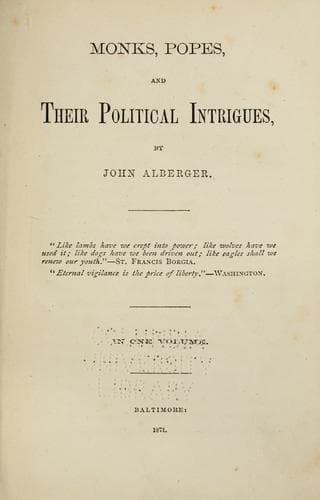
Monks, Popes, and their Political IntriguesAlberger, John
History
Monks, Popes, and their Political Intrigues
Alberger, John
Catholic Church; Catholic Church -- United States; Church and state
Cardinal Fiesco, a warm friend of the emperor, became Pope Innocent IV.;
but the dignity of pope making him regard the emperor as hostile to
his monarchial pretensions; converted his former friendship into bitter
annimosity. Returning to Lyons, he confirmed all the anathemas that had
been pronounced against Frederic, and summoned him to appear at the bar
of a grand council to be convened at that place. In the proceedings of
this council the most ridiculous and groundless charges were preferred
against Frederic, and though completely refuted by his deputies, yet as
the proceedure was merely the semblance of a judicial trial, to sanction
preconcerted malice and revenge by forms of legality, the council
did not hesitate to declare him guilty, any proof of innocence to the
contrary, It seems to have concentrated its ingenuity in devising new
and unheard of methods to give terrific importance to the ventilation
of its hate. An anathema was pronounced on the body and soul of the
emperor, and on all his interests, friends and allies. While pronouncing
these religious curses, the priests, like fiends administering at some
infernal ceremonies, held in their hands lighted torches, and upon its
conclusion suddenly extinguished them; and by the theatrical trick of
uttering discordant shrieks and howls, seemed in the darkness of the
cathedral to have converted the holy place into the lower regions,
peopled with the arch-fiend and his agents. Though these artistical
elaborations were not without some effect, yet the vigor of the
emperor's genius, the magnanimity which he constantly displayed, his
vast popularity, and the triumph of his arms--which continued to his
death--demonstrated to the intelligent that there was no real curse in
the papal anathemas.
Conrad IV., son of Frederic II., became emperor of Germany in 1250.
Innocent IV., whose policy it was to profess any friendship, and violate
any obligation that contributed to his interests, determined to complete
on the son the vengeance he had commenced on the father. Presumptuous
as vindictive he declared that inasmuch as Frederic II. had been
excommunicated, his son could not inherit the throne. On the ground
of this ridiculous pretext, he pronounced him dispossessed of all his
inheritance; laid on him an interdict; and persecuted him by all the
means which his power and influence afforded. But notwithstanding a
revengeful pope, whose malice through his machinery operated everywhere,
yet, he had more than his equal to contend with. The courage and heroism
of Conrad defeated the papal army, kept the pope's allies in check, and
was about to enter Lombardy with the fairest prospects of success when
his illegitimate brother, by administering poison to him, relieved the
pope of a formidable adversary.
Public-domain text, read in full here on John Shaqi.
Reviews
Reviews
No reviews yet
Be the first to share your thoughts on this work.
Elsewhere in the archive
Join the Discussion
Join the discussion
Sign in to leave a comment or review.
Sign InorCreate an account