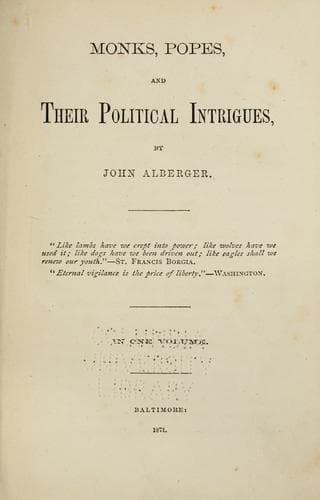
Monks, Popes, and their Political IntriguesAlberger, John
History
Monks, Popes, and their Political Intrigues
Alberger, John
Catholic Church; Catholic Church -- United States; Church and state
Conradin, son of Conrad IV., the last of the noble house of
Hohenstaufen, was the heir to the throne, The pope refused to
acknowledge his right to succession, because his father had been
excommunicated. He declared also that Conradin had forfeited his right
of inheritance to the crown of Naples and Sicily, and undertook to
bestow it on Charles of Anjou. But Conradin entered Italy and defeated
the usurper; but while he was pursuing the flying enemy with too much
recklessness, he was captured by the vanquished. The world expected
that his youth and valor could not but win compassion even from the
iron-hearted pope, but the intense hatred of the papal monarch to the
noble house of which this intrepid lad was the last scion, would
not permit him to allow an opportunity to escape of extinguishing it
forever. Conradin was therefore, though but sixteen years old, publicly
executed as a criminal; but his heroism, and the circumstances under
which he met death, crowned his memory with immortal honor, while it
cast a deeper tinge of ignominy on the already blackened character of
the pope.
The usurpation of territory, and interference in political affairs,
which are so strongly characteristic of the papal policy, originate from
the constitutional principles of the Roman See. In conformity with them
Pope Boniface VIII. proclaimed himself King of Rome; and declared that
the Roman See was the source whence the Germanic electors derived their
rights. Albert I. being chosen emperor by the electors in 1298; was
summoned by the pope to appear before him and apologize for having
accepted the crown without consulting his pleasure, and to expiate the
guilt of his offence by the performance of such penance as should be
prescribed. To enforce compliance with this injunction the pope formed
an allegiance with the archbishop of Mentz, a powerful military bishop,
and a former friend of Albert. To resist the belligerent pope Albert
effected an alliance with Philip la Belle, of France. Making a sudden
diversion into the electorate of Mentz, Albert obliged the bishop to
form a league with him for five years. The pope then suggested peaceful
negotiation rather than disastrous war. It was finally agreed between
the two contracting parties that the pope should give to Albert the
possessions of his ally, and that Albert should acknowledge that the
western empire was a grant as a fief from the pope, that the electors
derived their right from the Roman See, and that he would defend the
papal interests with his arms. The pope then proceeded, by virtue of an
excommunication, to invalidate the title of Louis la Belle, of France,
to his kingdom, and officially to transfer it to Albert I.
Public-domain text, read in full here on John Shaqi.
Reviews
Reviews
No reviews yet
Be the first to share your thoughts on this work.
Elsewhere in the archive
Join the Discussion
Join the discussion
Sign in to leave a comment or review.
Sign InorCreate an account