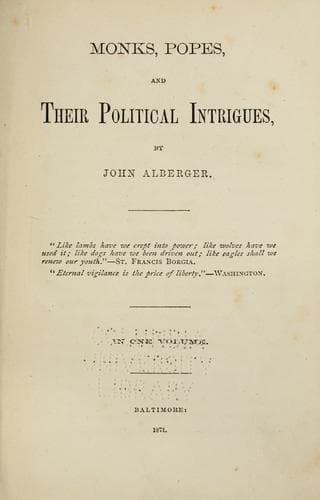
Monks, Popes, and their Political IntriguesAlberger, John
History
Monks, Popes, and their Political Intrigues
Alberger, John
Catholic Church; Catholic Church -- United States; Church and state
During the reign of Henry VII., who became emperor of Germany in 1308,
the tyranny and ambition of the pope were held in decent check, and the
Papal See was unusually quiet and respectable. The emperor, whom the
pope hated, but whom he dared not anathematize, was finally removed
by poison administered in the sacramental wine, by Moltipulcian, a
Dominican monk. Soon as this event occurred the pope's vengeance, which
had been accumulating in fury for years, but which was too much overawed
to utter a murmur, now burst forth with the most impetuous and indecent
violence in anathemas on the soul, the corpse, the coffin, and the tomb
of the dead emperor; but it is not supposed that they done any damage,
except to the character and good sense of the Roman See.
Louis IV., of Bavaria, became emperor of Germany in 1330, To arrest the
encroachments of the Papal See on the rights of the sovereignty of the
empire, the diet of Rense framed a constitution, in 1338, which provided
that the choice of the electors of the union should be final in
its decision, and independent of the Pope of Rome. These patriotic
proceedings seemed to the pope to be interfering with his rights; and
John XXI. accordingly prohibited the performance of divine worship in
the empire, until the obnoxious constitution should be annulled. But
Louis soon repaired this calamity by the creation of Pope Nicholas V.,
who, having equal authority with Pope John XXI., nullified all his
acts. Pope Clement VII., who succeeded to the papal throne in 1342,
excommunicated Louis, and by his intrigues caused five electors
to declare in favor of Charles of Luxemburg. This violation of the
celebrated constitution of 1338 induced three electors to assemble at
Lahstein, and declare the choice of Charles null and void; and as Louis
had died, they elected Edward of England, but he declining, they elected
Frederic the Severe; he also declining, the crown was finally settled
on Gunter of Schwarzburg. But Gunter being removed by poison, the papal
policy triumphed in the coronation of Charles of Luxemburg.
Public-domain text, read in full here on John Shaqi.
Reviews
Reviews
No reviews yet
Be the first to share your thoughts on this work.
Elsewhere in the archive
Join the Discussion
Join the discussion
Sign in to leave a comment or review.
Sign InorCreate an account