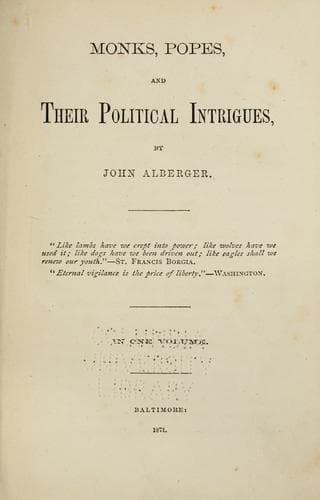
Monks, Popes, and their Political IntriguesAlberger, John
History
Monks, Popes, and their Political Intrigues
Alberger, John
Catholic Church; Catholic Church -- United States; Church and state
The papal power, at the period of Frederic II., seemed to tremble on
the verge of inevitable destruction; but by a profound and unscrupulous
policy, and a system of crafty intrigues, aided by a political machinery
whose various parts ramified every portion of the empire, and acted
in concert through all ages and dynasties, it had steadily carried its
advancements through the blood of millions and the ruins of thrones,
until, at the time of Charles, it had regained its supremacy in the
empire; and dictated treaties to the emperors, measures to the diets,
and laws to the people. A power that could at its option excite or quell
a popular outburst, create or destroy a dynasty, might be an object
of terror to people and princes, but never an object of reverence. The
dread it cast on the mind was always unpleasant, and in proportion
as its power became oppressive and disadvantageous, opposition and
resistance were inevitably excited. The love of independence, the native
individualism of the Germanic character, was always a mortal foe to
papal despotism. It might be cowered into silence, but it still grew
in vigor, became more impatient as the pope became more despotic, and
bolder as it became more conscious of its numerical strength. This
spirit, in 1411, when Sigismund became Emperor of Germany, displayed
an energy prophetic of stirring events and important consequences. The
spirit of Germanic individualism led distinguished men of the nation to
deny, with emphatic boldness, the pretensions of the pope; to denounce
the profligacy of the clergy; and to demand in the body and head of the
church a thorough reformation. Prominent among the apostles of religious
freedom, which rose into consequence at that time, was John Huss, and
his disciples. The success of these reformers excited and alarmed the
pope. Hating any semblance of a right to participate in his authority,
or to assume any approach to an equality with him, he was strongly
averse to the assembling of a deliberative council; but conscious that
his divine attributes and prerogatives were not adequate to the existing
emergency, he consented that the Council of Constance should be called,
on condition that it should adopt the most energetic means for the
extirpation of the heretics.. With the secret design of betraying the
amiable reformer, John Huss, he was invited to respond in person to
a summons of the council. To quiet his apprehensions of danger, the
emperor furnished him with a safe conduct, and the pope pledged his
honor to protect him from harm. Thus guarded by the honor of the state
and the church, he was, notwithstanding, perfidiously betrayed, and
condemned to be burnt alive. The perfidy of the infallible pope is
justified by the saints and authorities of the Catholic church, on the
ground that no pledge, assurance, or oath, can rightfully protect a
heretic from punishment. Sigis-mund attended the horrid ceremonies; and
Public-domain text, read in full here on John Shaqi.
Reviews
Reviews
No reviews yet
Be the first to share your thoughts on this work.
Elsewhere in the archive
Join the Discussion
Join the discussion
Sign in to leave a comment or review.
Sign InorCreate an account