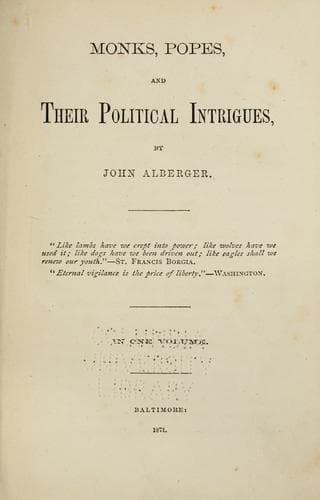
Monks, Popes, and their Political IntriguesAlberger, John
History
Monks, Popes, and their Political Intrigues
Alberger, John
Catholic Church; Catholic Church -- United States; Church and state
being reminded by a by-stander that the course of the wind might bear an
offensive efluvia to the position he occupied, answered: "The odor of a
burning heretic can never be offensive to Sigismund."
The death of John Huss was terribly revenged. The stake became the
watchword of union. The hitherto mild and submissive reformers became
desperate revengers. Churches and convents were burnt; monks and priests
slaughtered without mercy. The insurgents met and defeated the imperial
forces. The strongest armies of the cross withered before their
ferocity. For fifteen years they devastated the Papal dominions, and
shook the government with the violence of their retribution. Seeing
it impossible to restrain their rage, Sigismund obliged the Council of
Basle to negotiate with them for the adjustment of their difficulties.
This politic measure so incensed Pope Eugenius IV., whose uncompromising
vengeance longed for the extermination of every opponent to papal
despotism, that he ordered his legates to dissolve the obnoxious
assembly. But the laity had advanced in liberality and knowledge far
beyond the possible attainment of a papal despot, and in defiance of
his maledictions and intrigues, continued their useful session, and
terminated, by peaceful concessions, the war with the Hussites.
The grand struggle between religious freedom and Catholic despotism
was visibly approaching when Charles V., King of Spain, in 1519 became
Emperor of Germany. His design was to conquer the world, and his policy
was to unite all parties in augmenting the national strength. To
secure the favor of the pope, and the co-operation of his extensive and
effective machinery, he declared himself the defender of the Catholic
faith. To conciliate the Protestants he convened a diet at Worms, at
which, under a plausible show of toleration he allowed Luther, in his
presence, to defend the principles of the reformation. But his ambiguous
policy becoming offensive to the Roman See, he issued an edict against
the Protestants. A Catholic from interest, he was more disposed to make
the pope auxiliary to the success of his designs than to be governed by
him. Hence, when Francis I. preferred claims to certain portions of the
Germanic empire, he leagued with the pope and accomplished the defeat
of the king; but he was equally disposed to defend his interests against
the pope. The papal monarch, always apprehensive of the political power
of friend or foe, seeing that his confederacy with Charles had vastly
augmented the latter's preponderating power, and placed the papal
interests at his disposal, formed against him a counter league with the
Italian States. This effort to retrieve the errors of his policy only
aggravated his misfortune. The forces of the Holy League were defeated
by the arms of Charles, Rome taken by storm, the city plundered, the
pope imprisoned, and four hundred thousand crowns of gold demanded for
his ransom. When Charles heard of the success of his arms, in evident
Public-domain text, read in full here on John Shaqi.
Reviews
Reviews
No reviews yet
Be the first to share your thoughts on this work.
Elsewhere in the archive
Join the Discussion
Join the discussion
Sign in to leave a comment or review.
Sign InorCreate an account