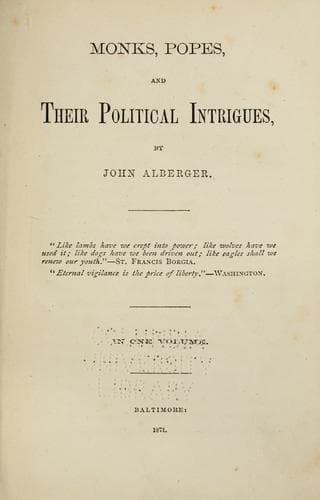
Monks, Popes, and their Political IntriguesAlberger, John
History
Monks, Popes, and their Political Intrigues
Alberger, John
Catholic Church; Catholic Church -- United States; Church and state
On the death of Maria Theresa, Joseph, her son, succeeded to the throne
of Austria. Maria Theresa was a very devout and superstitious princess,
a circumstance which enabled the sacerdotal fraternity to gain and
betray her confidence. But in making her an object of their craft they
made her son their enemy. Their duplicity having excited in the mind of
Joseph a strong aversion to the intermeddling and intriguing profession,
he no sooner ascended the throne than he manifested a disposition to
adopt a policy more in accordance with the enlightenment of the age than
was agreeable to the pope and the clergy. The world with pleasure, but
the church with consternation, beheld him enlarging the liberty of the
press, tolerating the Protestants, treating the Jews with moderation,
annulling ecclesiastical sinecures, and abolishing such monasteries and
nunneries as were not useful as schools or hospitals. Uneasy at these
useful reforms, yet not daring to mutter his Vatican thunder, and
finding his machinery unable to stop their progress, Pope Pius IV.
sought a personal interview with the liberal minded emperor, to dissuade
him from the further prosecution of his beneficent intentions. But
notwithstanding the earnest remonstrances of the vicar of Christ, the
emperor still continued to reduce the number of the monasteries, and to
effect reforms in the churches, and in the various departments of the
government. This wise and sagacious policy, which relieved the people of
the oppression of spiritual despotism, and renewed the vigor of national
energy, was not appreciated by the masses through the ignorance and
superstition of the age. The emperor not only had to contend with
opposition from those for whose moral advancement he was laboring, but
also with the disguised hostility of the pope, and the subtle operation
of his treacherous machinery. But still, amid wars, seditions and
rebellions, he pursued his magnanimous policy; and if he did not effect
all the reforms in the church, and in his government, that he had
contemplated, it was more through the intrigues of the pope than through
any want of disposition, skill and energy on his part.
Public-domain text, read in full here on John Shaqi.
Reviews
Reviews
No reviews yet
Be the first to share your thoughts on this work.
Elsewhere in the archive
Join the Discussion
Join the discussion
Sign in to leave a comment or review.
Sign InorCreate an account